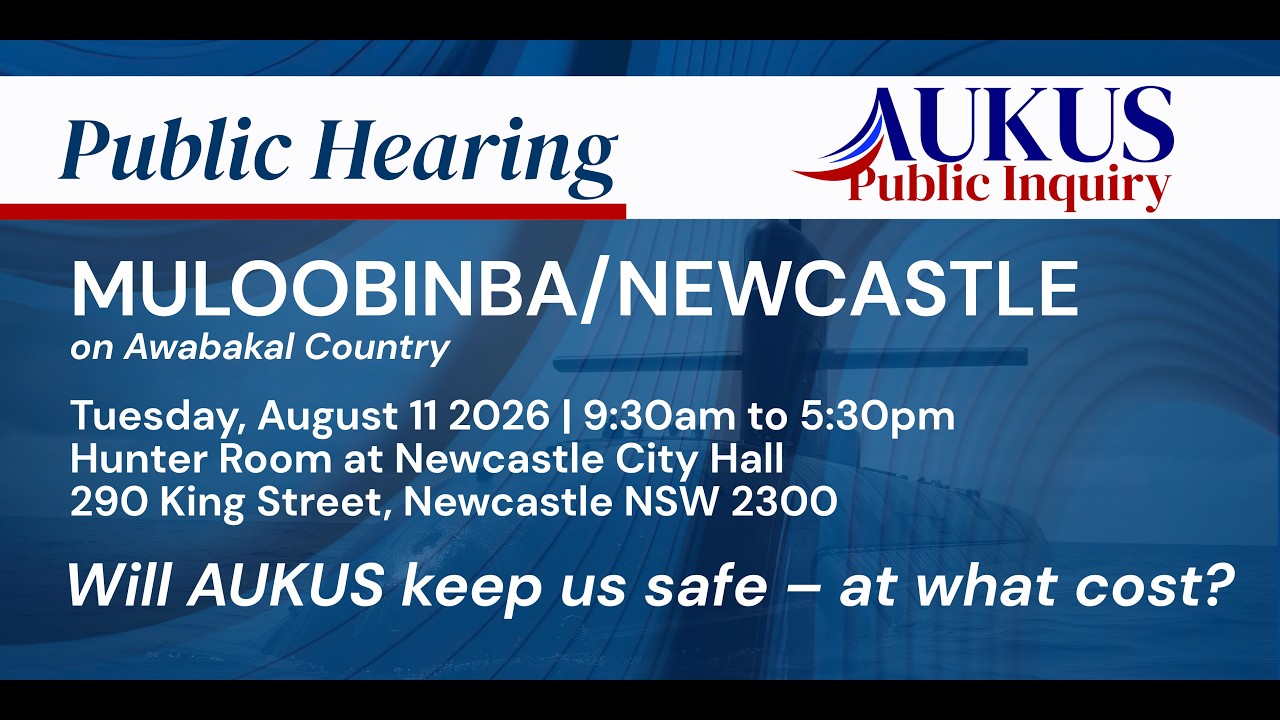
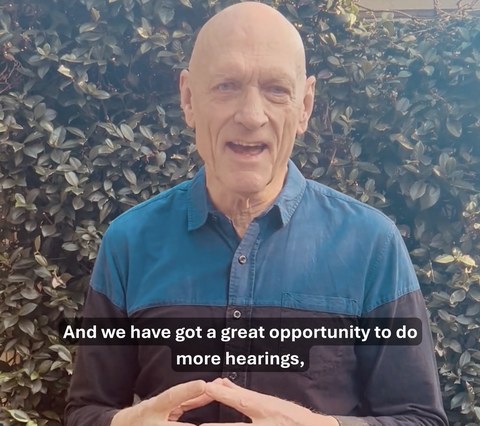
Will AUKUS keep us safe — at what cost?
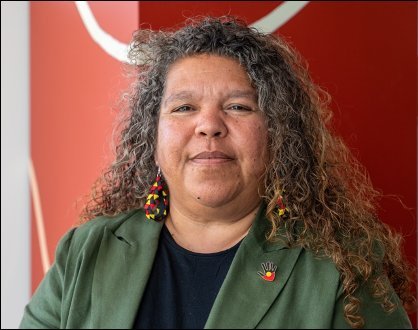
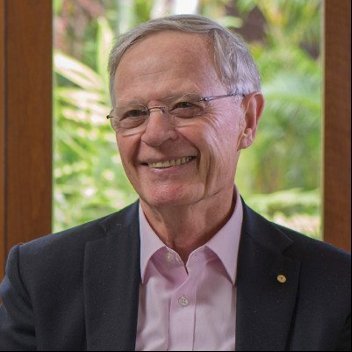
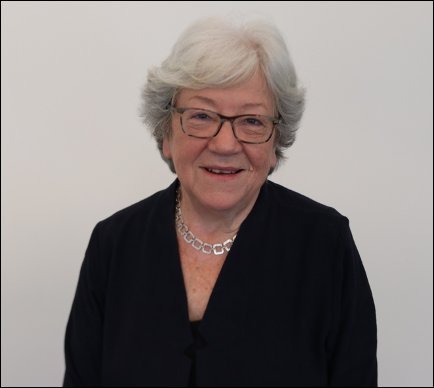
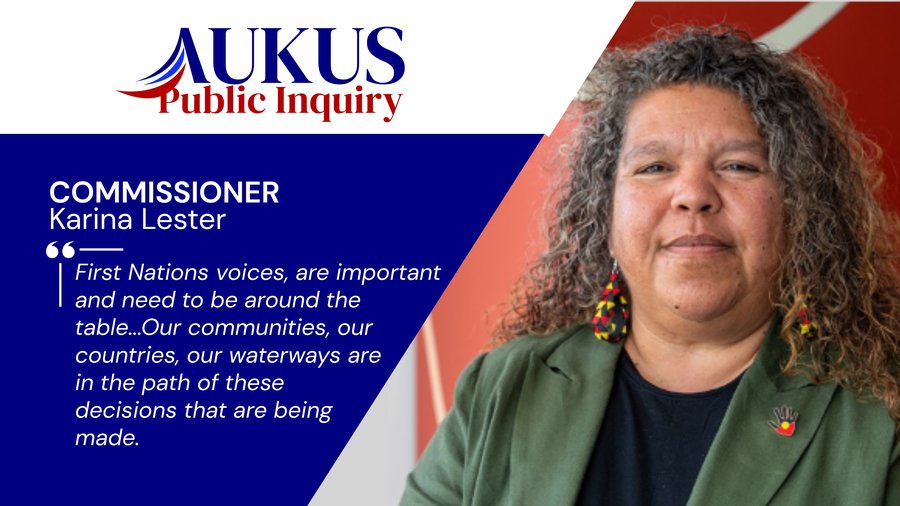
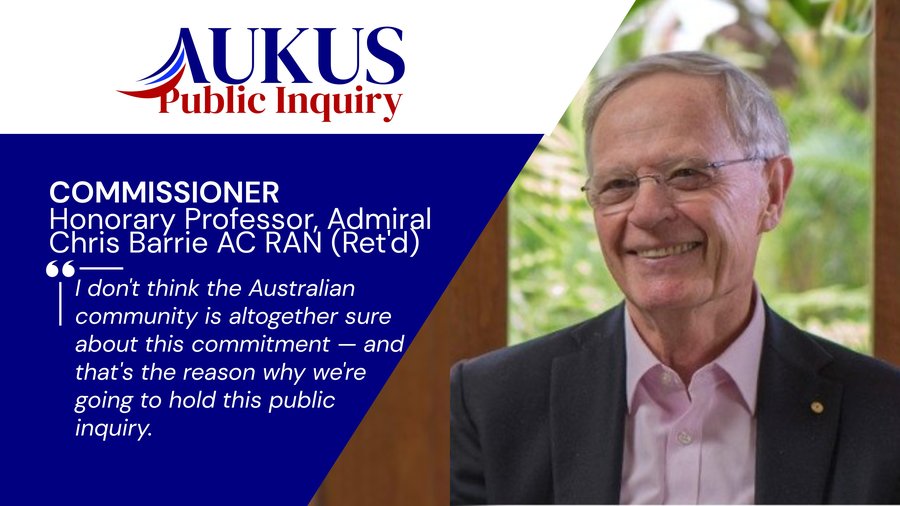
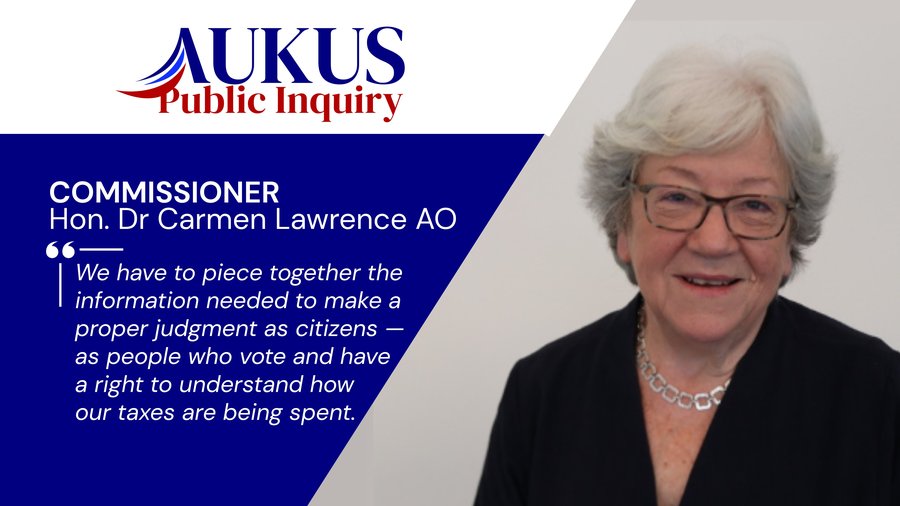
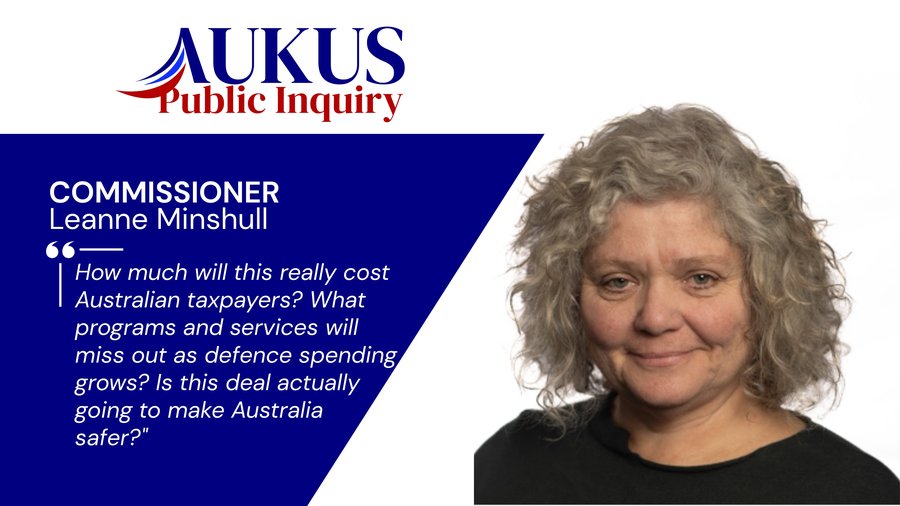
Click each card to read their full biography.
The AUKUS deal was conceived in secret and with deception — and continues to be shrouded in secrecy despite the incredibly high stakes and massive cost. Our government has already spent $10 billion of our taxes on US and UK shipyards at a time when much of the world is in conflict and Australians are suffering from a cost-of-living crisis.
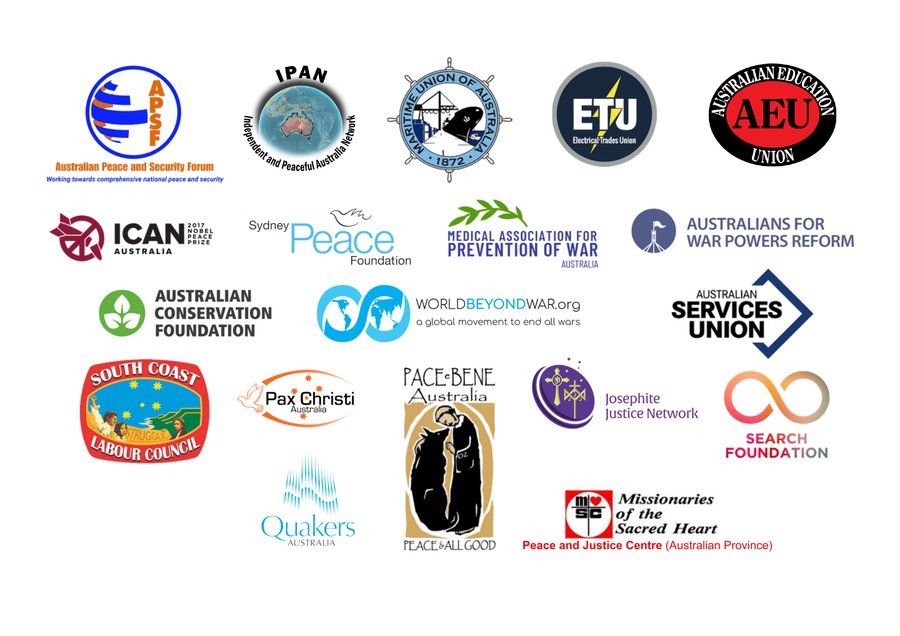
A group of former MPs, retired military and naval officers, leading strategists and academics, human rights lawyers and union leaders are committing to an independent Public Inquiry into AUKUS. This Inquiry is coordinated by the Australian Peace and Security Forum (APSF) — ensuring it is grounded in expertise, independence, and a commitment to serious evidence-based examination.
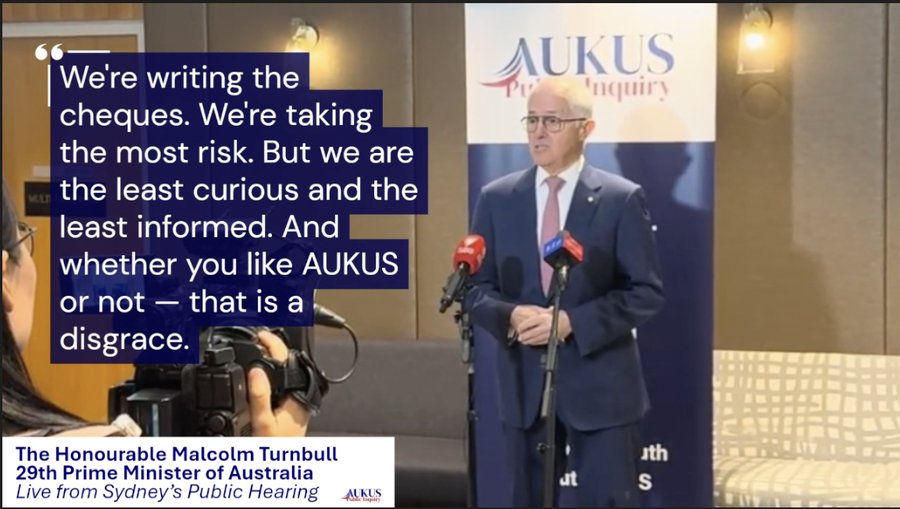
"We're writing the cheques. We're taking the most risk. But we are the least curious and the least informed. And whether you like AUKUS or not — that is a disgrace."— The Hon. Malcolm Turnbull AC, 29th Prime Minister of Australia
"So many questions, so few answers. The Australian public deserve more than Cold War rhetoric to justify the mind-boggling expenditure associated with acquiring second-hand, and yet to be designed attack class, nuclear propelled submarines."— Doug Cameron, former ALP Senator
"AUKUS represents the worst defence decision since we relied on Britain to protect us in World War II."— Major General Michael G Smith AO (Ret'd)
"Australia is spending an eye-watering amount to build a capability to defend us from a military threat which in fact is most likely to arise because we have that capability."— Prof. Hon. Gareth Evans AC KC FASSA FAIIA, Former Minister for Foreign Affairs
From financial accountability to nuclear risk — these are the critical areas under review.
Is the $368B+ price tag accurate? What are the opportunity costs for national security, housing, jobs, healthcare, education, climate action, and Closing the Gap between Aboriginal and Torres Strait Islander peoples and non-Indigenous Australians?
Does AUKUS genuinely enhance Australian security, or does it increase our exposure to great-power conflict with China?
Is AUKUS locking Australia further into the US war machine at the expense of our independence as a middle power?
Does the transfer of nuclear technology set a dangerous precedent? What are the implications for our existing nuclear non-proliferation treaty commitments? Where and how will medium and high-level nuclear waste be stored? What are the long-term environmental risks of operating nuclear-powered submarines in Australian waters?
What is the impact of AUKUS on Australia's tertiary sector, research institutions, and universities? How is the expansion into AI, autonomous weapons, and emerging technologies reshaping Australian defence, and at what cost to sovereign capability? Why must technological advancement be progressed primarily under the AUKUS banner?
Were credible and less costly alternatives to AUKUS properly assessed before the decision was made in secret?
Submissions to the AUKUS Public Inquiry are now closed. Browse written submissions received, in order of most recently submitted — we received over 1,000 in total, and this section continues to be populated as they are processed and cleared for publication.
Scroll to browse and click on a submission to open in a new tab
The following written submissions were received ahead of the Melbourne/Naarm hearing on 11 June 2026, presented in the order in which speakers appeared on the day.
The following written submissions and hearing transcripts relate to the Walyalup/Fremantle hearing, presented in the order in which speakers appeared on the day.
The following written submissions and hearing transcripts relate to the Tarndanya/Adelaide hearing, presented in the order in which speakers appeared on the day.
The following written submissions and hearing transcripts relate to the Sydney hearing, presented in the order in which speakers appeared on the day.
The following written submissions relate to the Newcastle hearing, presented in the order in which speakers appeared on the day. Transcripts for two speakers are still pending and will be added once available.
The following written submissions relate to the Wollongong hearing, presented in the order in which speakers appeared on the day. Transcripts for some speakers are still pending and will be added once available.
The following written submissions relate to the Brisbane hearing, presented in the order in which speakers appeared on the day. Transcripts for some speakers are still pending and will be added once available.
The following written submissions relate to the first day of the Canberra hearing, presented in the order in which speakers appeared on the day.
The following written submissions relate to the second day of the Canberra hearing, presented in the order in which speakers appeared on the day. Submissions for some speakers are still pending and will be added once available.
Submissions to the AUKUS Public Inquiry have now closed. We have received over 1,000 submissions and thank everyone who has contributed. Submissions are now being processed and will be published on a rolling basis. The commissioners report will be made available on 4 November, 2026.
Public hearings and webinars were held across Australia and online. The recordings below are available to watch in full. Locations included:
Presentations were delivered by invited submitters and Commissioners engaged with the evidence provided. Short presentations were also welcomed on the day without a prior submission, subject to time and availability.
Canberra — Day Two Full Hearing Recording
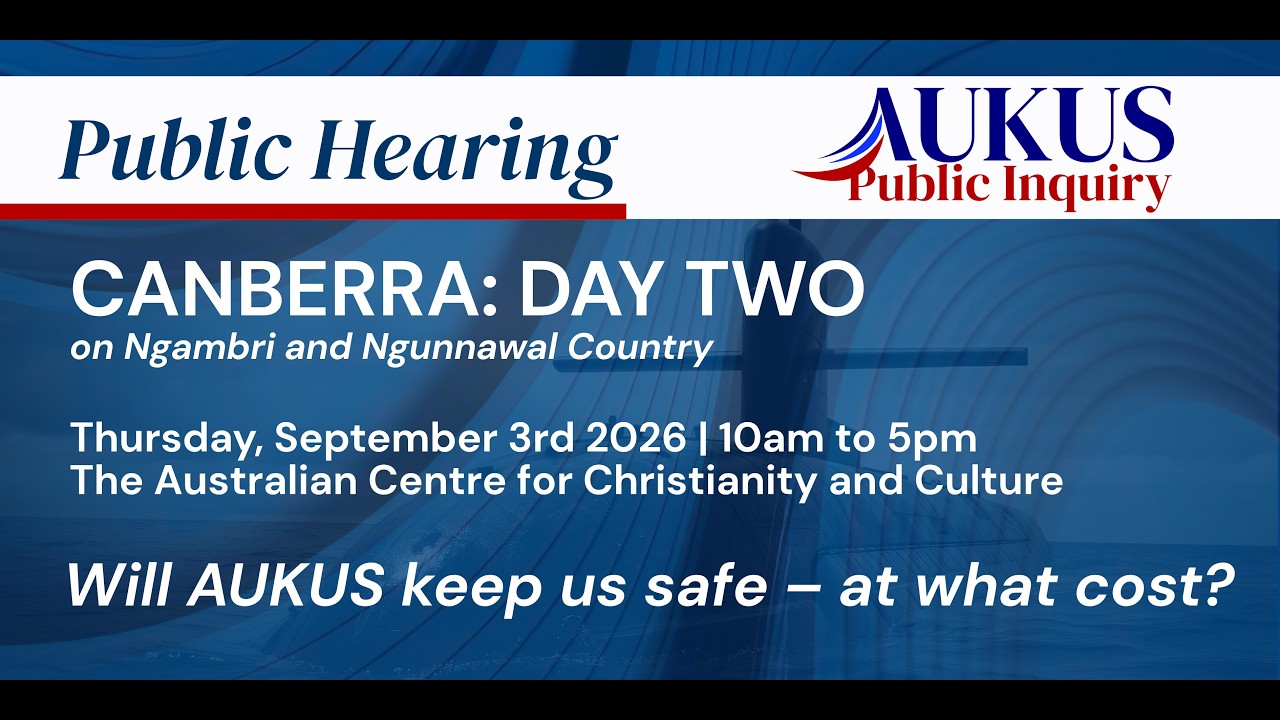
Canberra Public Hearing — Day Two, 3 September 2026
Australian Centre for Christianity and Culture (ACCC), Barton ACT
The second day of the Canberra public hearing brought our public hearings across the country to a close, drawing together voices from academia, politics, journalism, and civil society for a final day of testimony on AUKUS.
Featured Witness
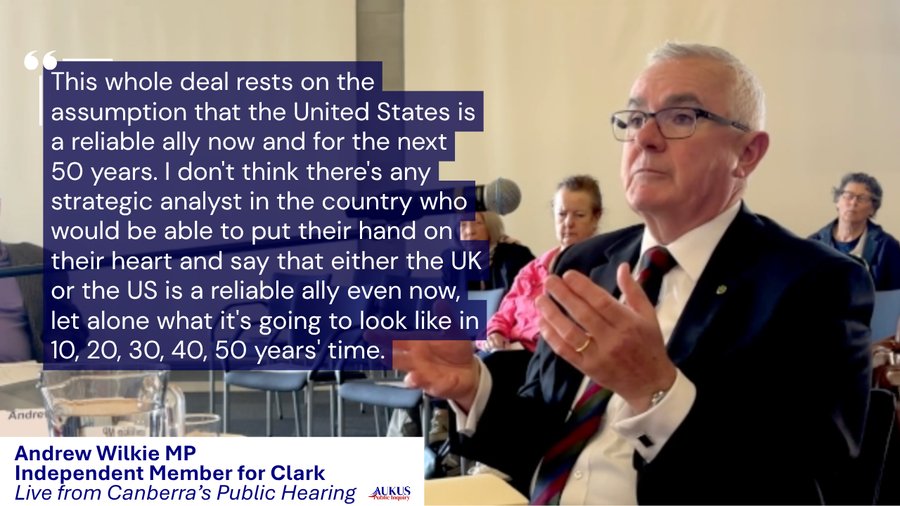
Andrew Wilkie MP: “We Are Shocked by the Complete Abandonment of Proper Process”
Independent Member for Clark
“This whole deal rests on the assumption that the United States is a reliable ally now and for the next 50 years. I don't think there's any strategic analyst in the country who would be able to put their hand on their heart and say that either the UK or the US is a reliable ally even now, let alone what it's going to look like in 10, 20, 30, 40, 50 years' time.”
Featured Witness
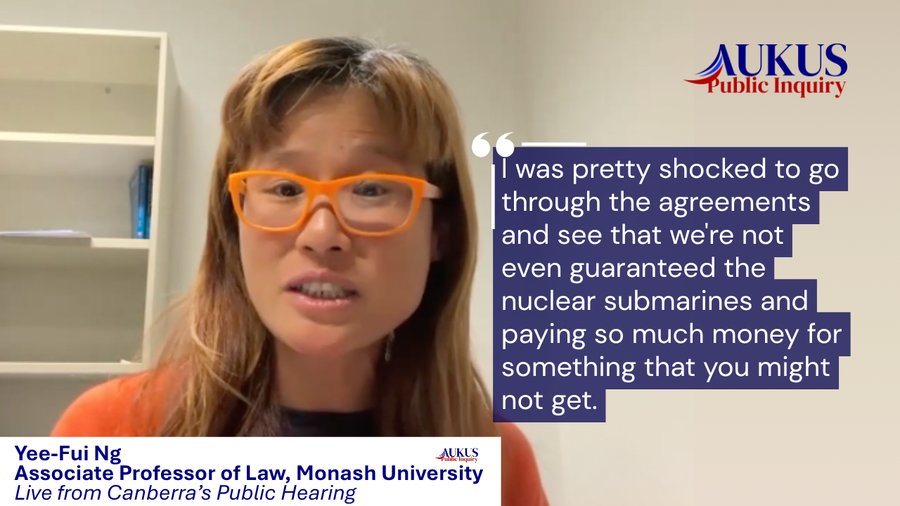
Yee-Fui Ng: “We're Not Even Guaranteed the Nuclear Submarines”
Associate Professor of Law, Monash University
“I was pretty shocked to go through the agreements and see that we're not even guaranteed the nuclear submarines and paying so much money for something that you might not get.”
Featured Witness
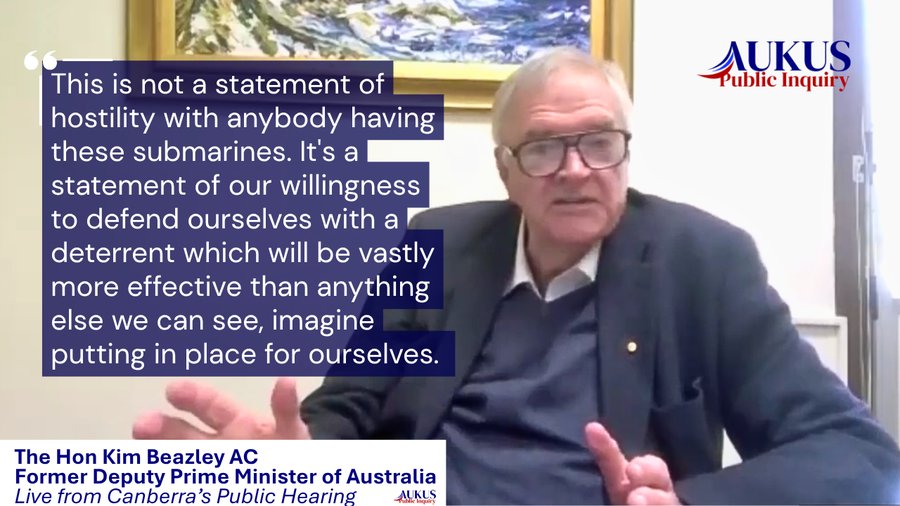
The Hon. Kim Beazley AC: “It Will Be a Political Decision Whether or Not They Turn Up”
Former Deputy Prime Minister of Australia
“This is not a statement of hostility with anybody having these submarines. It's a statement of our willingness to defend ourselves with a deterrent which will be vastly more effective than anything else we can see, imagine putting in place for ourselves.”
Featured Witness
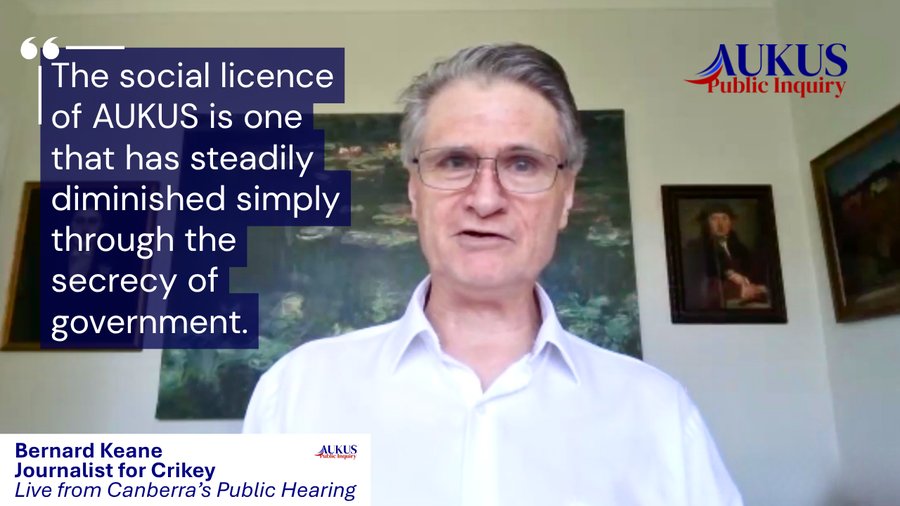
Bernard Keane: “The Social Licence of AUKUS Has Steadily Diminished”
Journalist for Crikey
“The social licence of AUKUS is one that has steadily diminished simply through the secrecy of government.”
Featured Witness
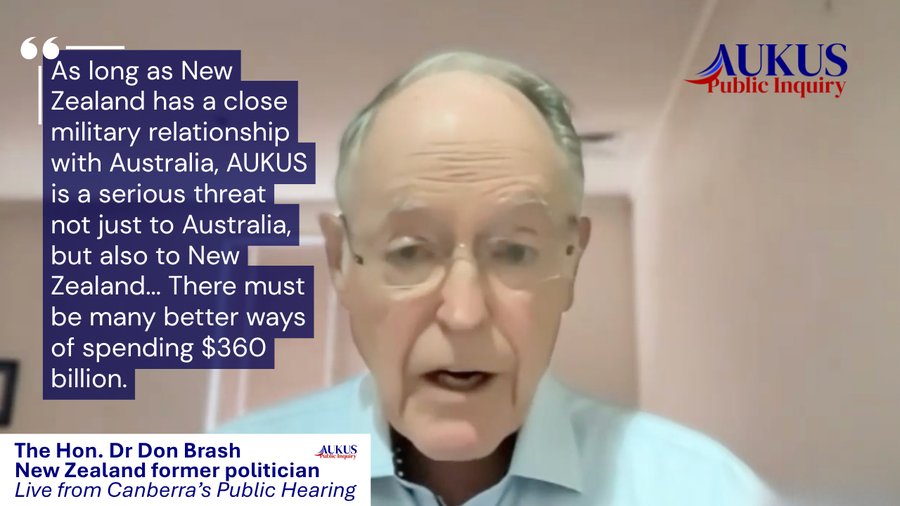
Dr Don Brash: “AUKUS Simply Plants a Target on Australia's Back and Hands the Trigger to Washington”
New Zealand Former Politician
“As long as New Zealand has a close military relationship with Australia, AUKUS is a serious threat not just to Australia, but also to New Zealand… There must be many better ways of spending $360 billion.”
Featured Witness
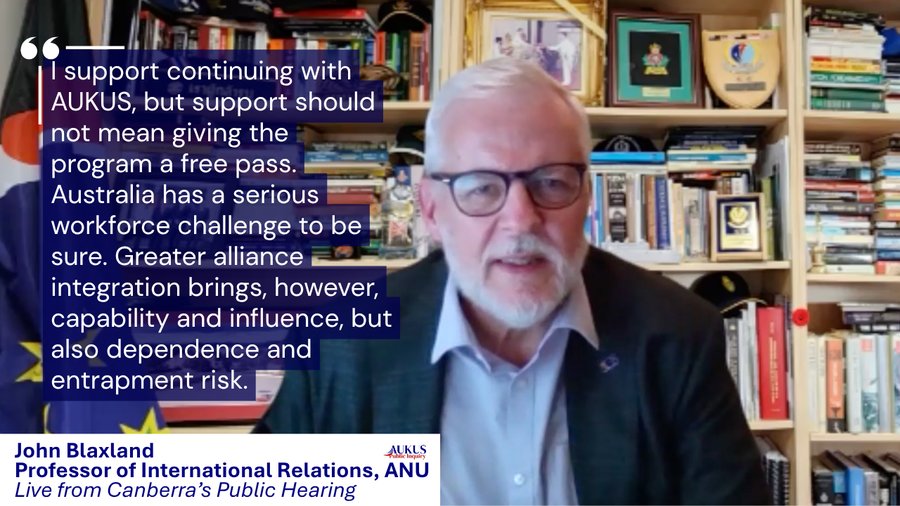
John Blaxland: “Support Should Not Mean Giving the Program a Free Pass”
Professor of International Relations, ANU
“I support continuing with AUKUS, but support should not mean giving the program a free pass. Australia has a serious workforce challenge to be sure. Greater alliance integration brings, however, capability and influence, but also dependence and entrapment risk.”
Featured Witness
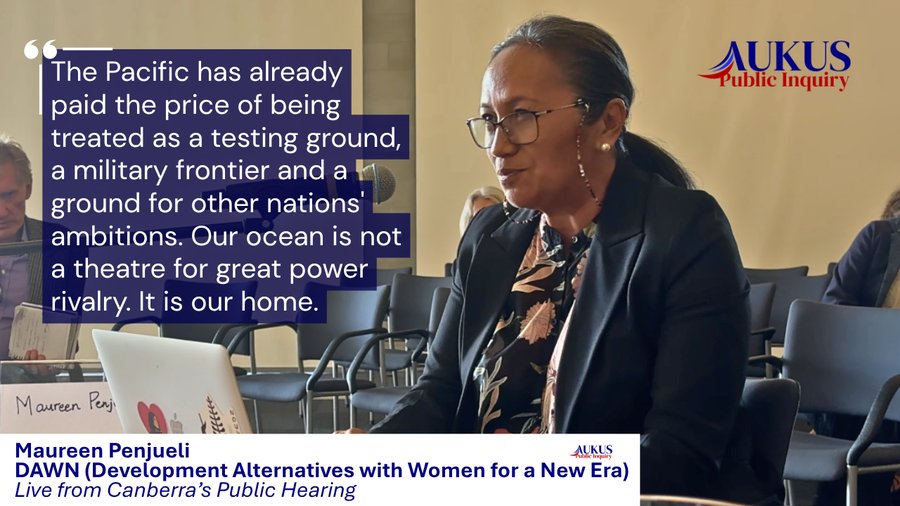
Maureen Penjueli: “The Pacific Has Already Paid the Price of Being Treated as a Testing Ground”
DAWN (Development Alternatives with Women for a New Era)
“The Pacific has already paid the price of being treated as a testing ground, a military frontier and a ground for other nations' ambitions. Our ocean is not a theatre for great power rivalry. It is our home.”
Canberra — Day One Full Hearing Recording
Canberra Public Hearing — Day One, 2 September 2026
Australian Centre for Christianity and Culture (ACCC), Barton ACT
The first day of the Canberra public hearing brought the AUKUS Public Inquiry to the national capital, hearing from a wide range of witnesses on the strategic, financial, and democratic implications of the agreement.
Featured Witness
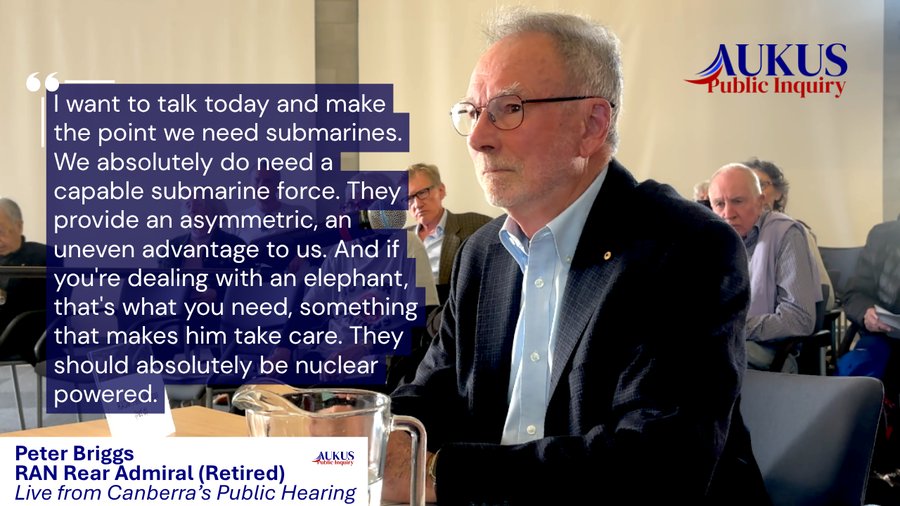
Peter Briggs: “We Absolutely Do Need a Capable Submarine Force”
RAN Rear Admiral (Retired)
“I want to talk today and make the point we need submarines. We absolutely do need a capable submarine force. They provide an asymmetric, an uneven advantage to us. And if you're dealing with an elephant, that's what you need, something that makes him take care. They should absolutely be nuclear powered.”
Featured Witness
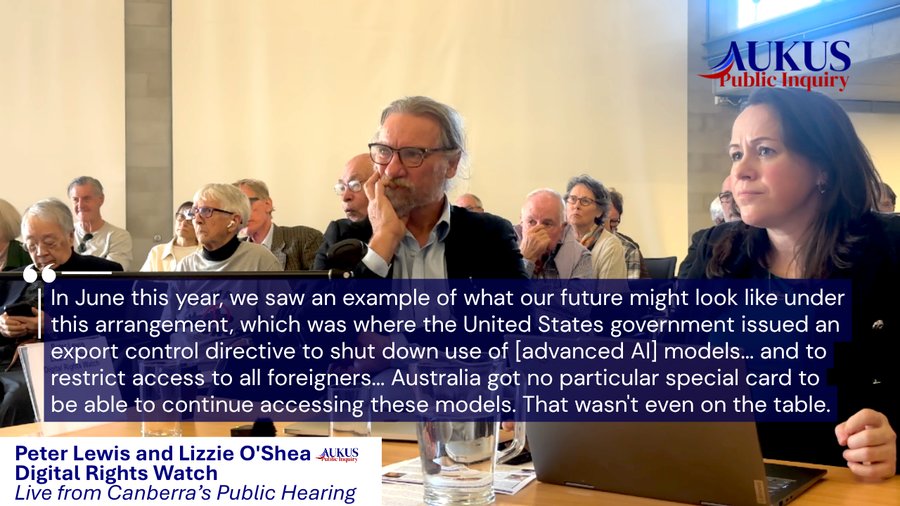
Digital Rights Watch: “A Lot of Consumer Tech Companies Are Also Military Contractors”
Peter Lewis & Lizzie O'Shea, Digital Rights Watch
“In June this year, we saw an example of what our future might look like under this arrangement, which was where the United States government issued an export control directive to shut down use of [advanced AI] models… and to restrict access to all foreigners… Australia got no particular special card to be able to continue accessing these models. That wasn't even on the table.”
Featured Witness
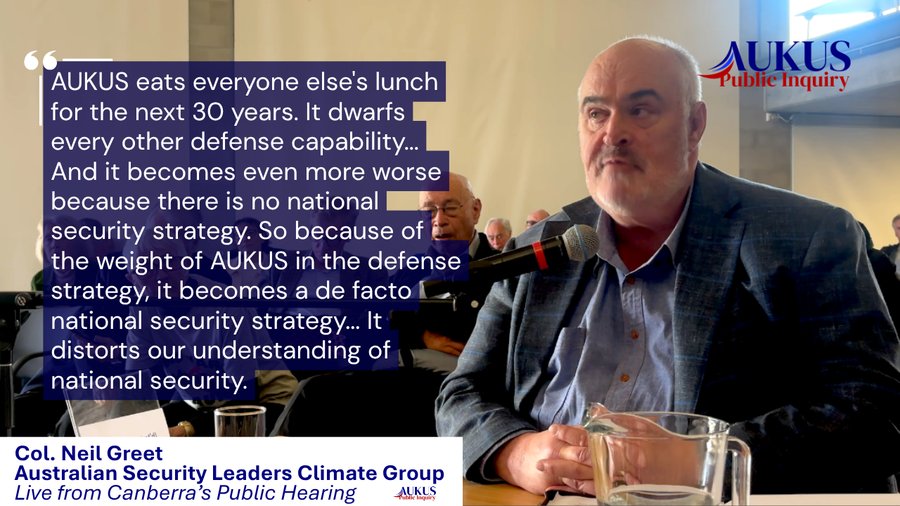
Col. Neil Greet: “AUKUS Eats Everyone Else's Lunch for the Next 30 Years”
Australian Security Leaders Climate Group
“AUKUS eats everyone else's lunch for the next 30 years. It dwarfs every other defense capability… And it becomes even more worse because there is no national security strategy. So because of the weight of AUKUS in the defense strategy, it becomes a de facto national security strategy… It distorts our understanding of national security.”
Featured Witness
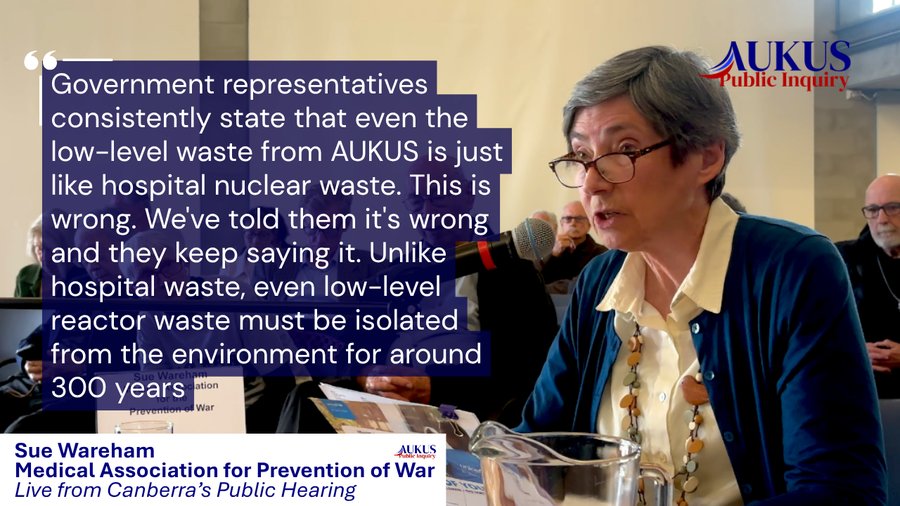
Sue Wareham: “This Is Wrong. We've Told Them It's Wrong and They Keep Saying It.”
Medical Association for the Prevention of War
“Government representatives consistently state that even the low-level waste from AUKUS is just like hospital nuclear waste. This is wrong. We've told them it's wrong and they keep saying it. Unlike hospital waste, even low-level reactor waste must be isolated from the environment for around 300 years.”
Featured Witness
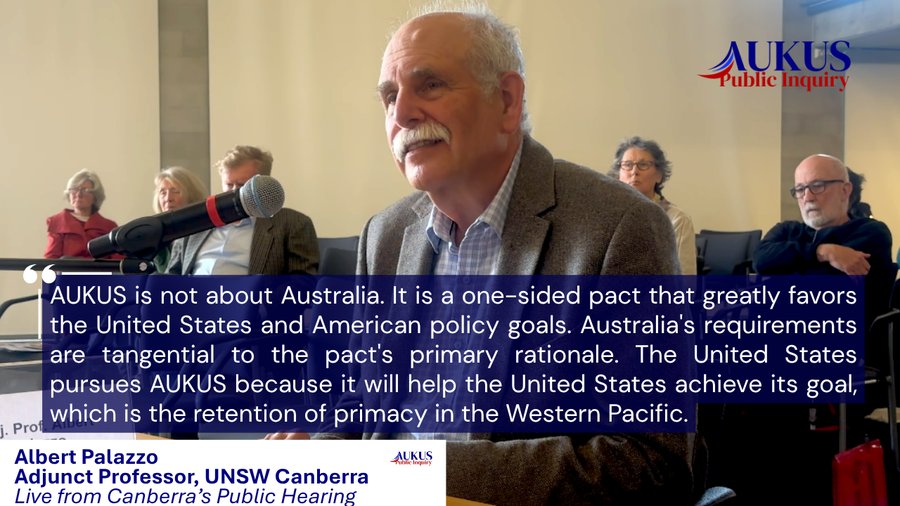
Al Palazzo: “The Stupidest Defense Policy Australia Has Ever Enacted”
Adjunct Professor, UNSW Canberra
“AUKUS is not about Australia. It is a one-sided pact that greatly favors the United States and American policy goals. Australia's requirements are tangential to the pact's primary rationale. The United States pursues AUKUS because it will help the United States achieve its goal, which is the retention of primacy in the Western Pacific.”
Featured Witness
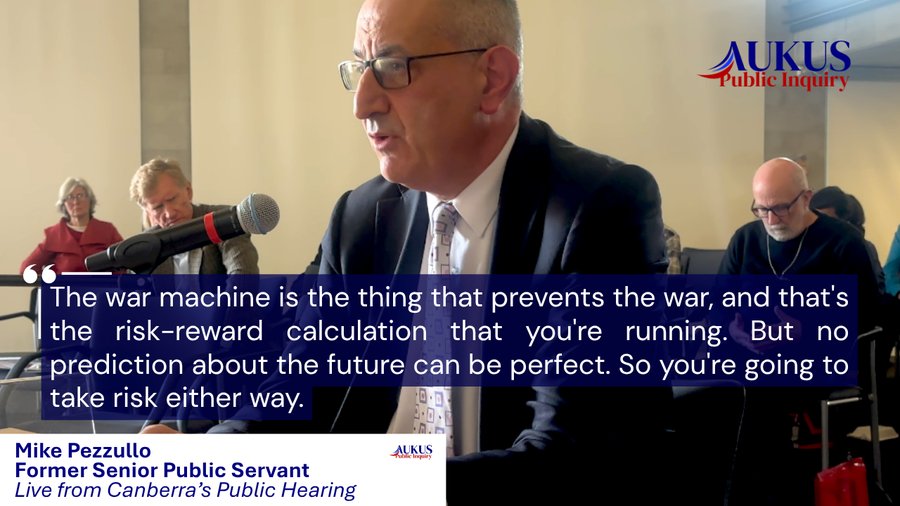
Mike Pezzullo: “The War Machine Is the Thing That Prevents the War”
Former Senior Public Servant
“The war machine is the thing that prevents the war, and that's the risk-reward calculation that you're running. But no prediction about the future can be perfect. So you're going to take risk either way.”
Featured Witness
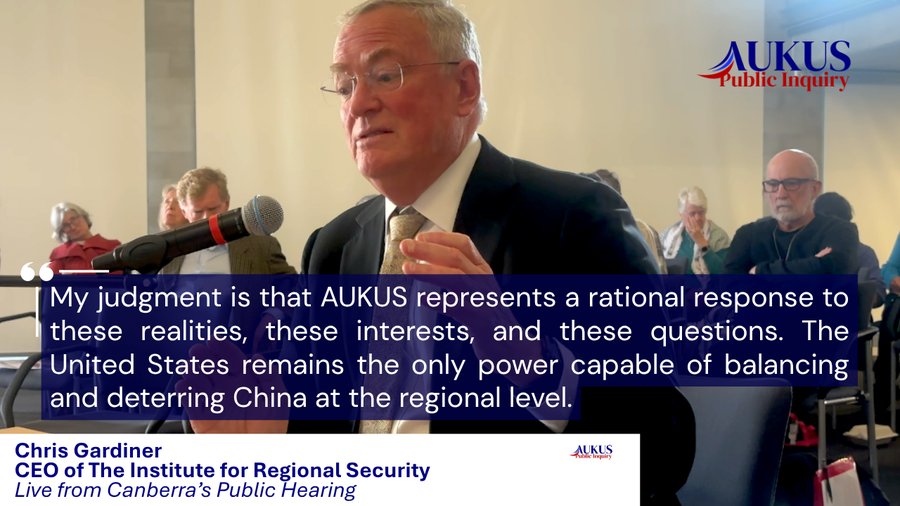
Chris Gardiner Says “AUKUS Represents a Rational Response”
CEO of The Institute for Regional Security
“My judgment is that AUKUS represents a rational response to these realities, these interests, and these questions. The United States remains the only power capable of balancing and deterring China at the regional level.”
Featured Witness
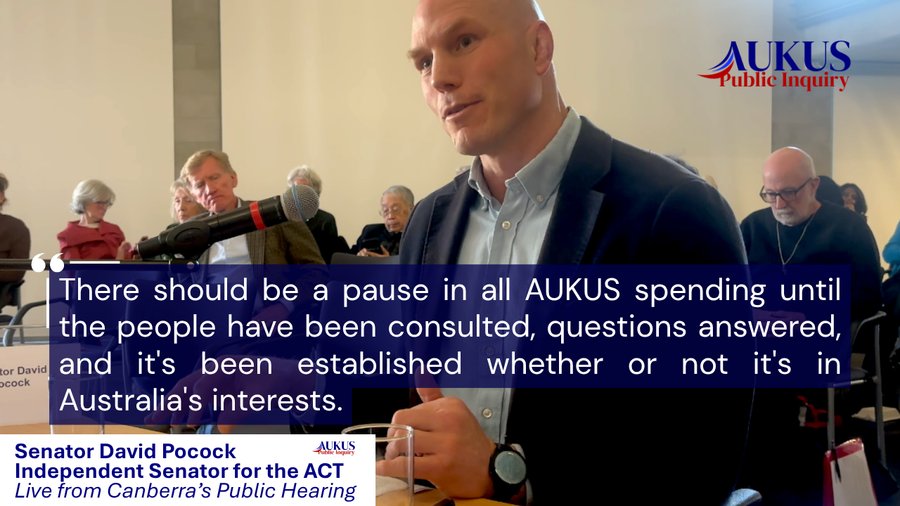
Senator David Pocock: “We're Not Even Guaranteed the Nuclear Submarines”
Independent Senator for the ACT
“There should be a pause in all AUKUS spending until the people have been consulted, questions answered, and it's been established whether or not it's in Australia's interests.”
Featured Witness
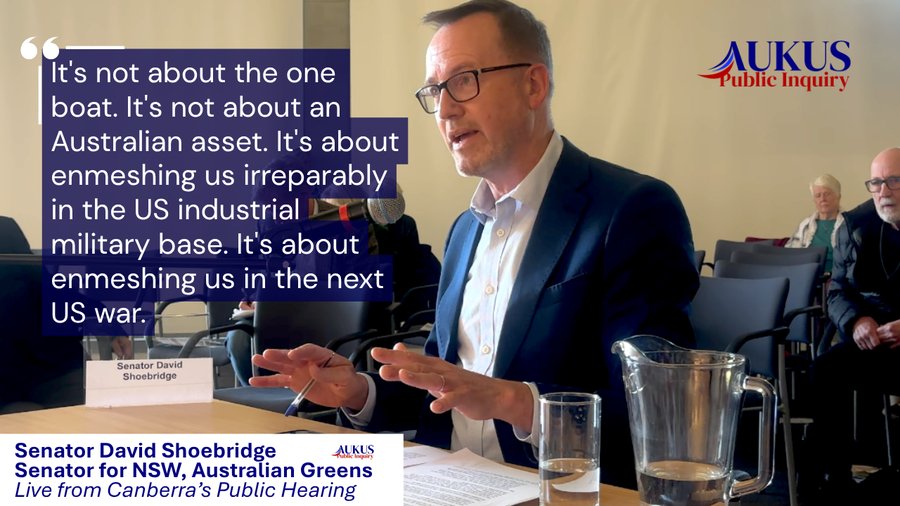
Senator David Shoebridge: “They Have Chosen to Bring the Front Line of Their War Into Australia”
Senator for NSW, Australian Greens
“It's not about the one boat. It's not about an Australian asset. It's about enmeshing us irreparably in the US industrial military base. It's about enmeshing us in the next US war.”
Brisbane — Full Hearing Livestream
Brisbane Public Hearing — 25 August 2026
Queensland Council of Unions (QCU), South Brisbane QLD
The Brisbane public hearing of the AUKUS Public Inquiry brought together academics, unionists, and concerned citizens to examine the strategic, financial, and social implications of the AUKUS agreement.
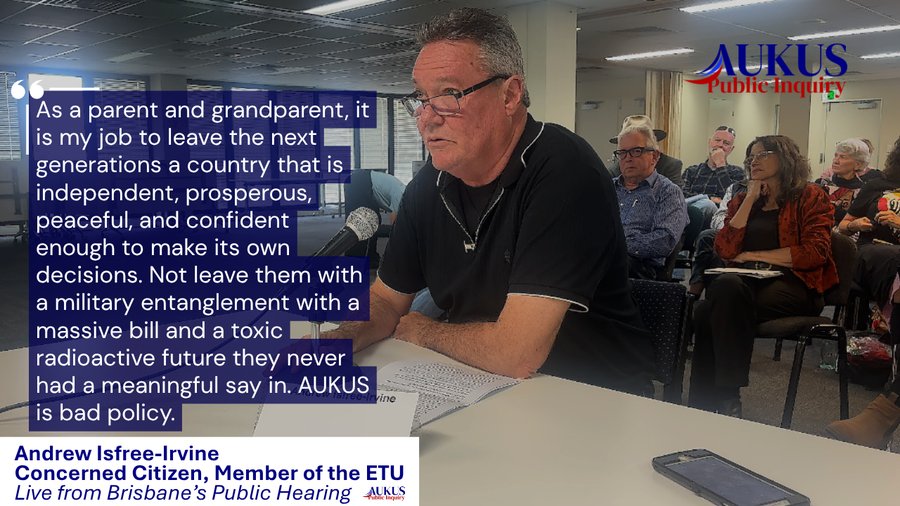
Featured Witness
Andrew Isfree-Irvine: “AUKUS Equals Intergenerational Disadvantage”
Concerned Citizen, Member of the ETU
“As a parent and grandparent, it is my job to leave the next generations a country that is independent, prosperous, peaceful, and confident enough to make its own decisions. Not leave them with a military entanglement with a massive bill and a toxic radioactive future they never had a meaningful say in. AUKUS is bad policy.”
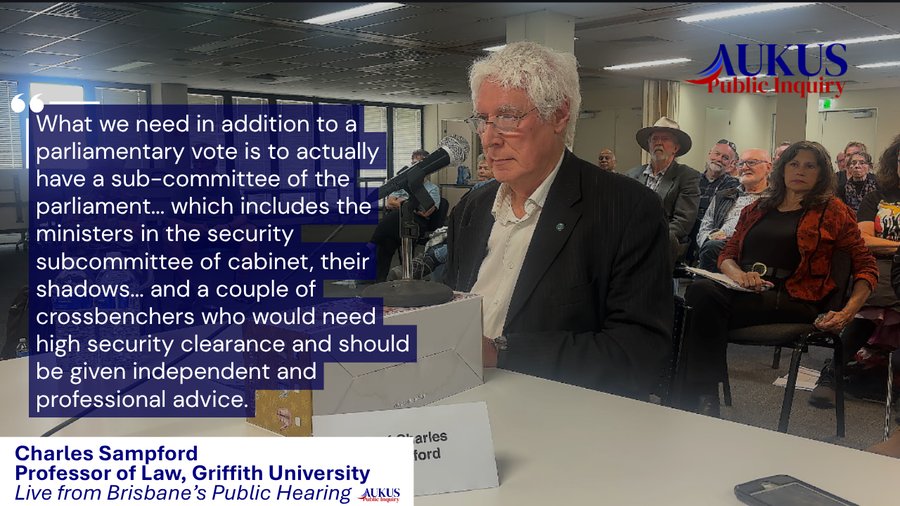
Featured Witness
Prof Charles Sampford: “We Need to Be Able to Speak Out”
Professor of Law, Griffith University
“What we need in addition to a parliamentary vote is to actually have a sub-committee of the parliament… which includes the ministers in the security subcommittee of cabinet, their shadows… and a couple of crossbenchers who would need high security clearance and should be given independent and professional advice.”
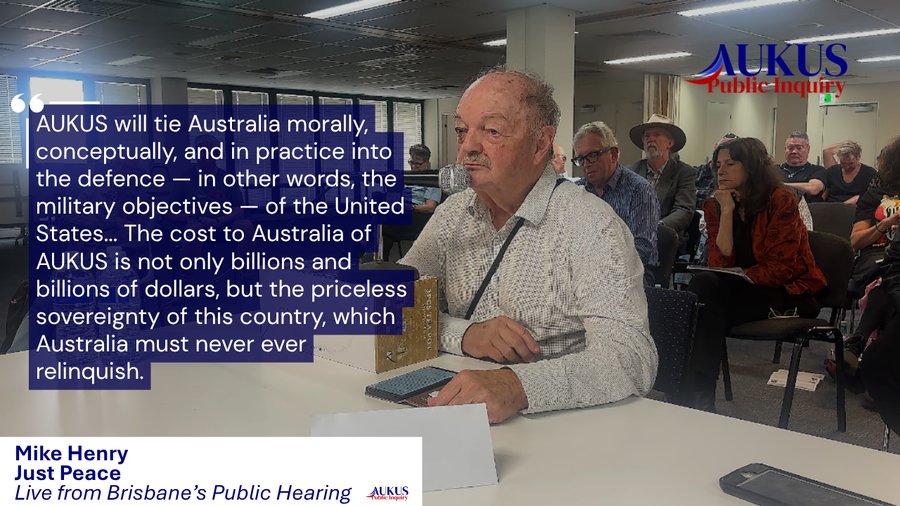
Featured Witness
Mike Henry: “The Priceless Sovereignty of This Country”
Just Peace
“AUKUS will tie Australia morally, conceptually, and in practice into the defence — in other words, the military objectives — of the United States… The cost to Australia of AUKUS is not only billions and billions of dollars, but the priceless sovereignty of this country, which Australia must never ever relinquish.”
Featured Witness
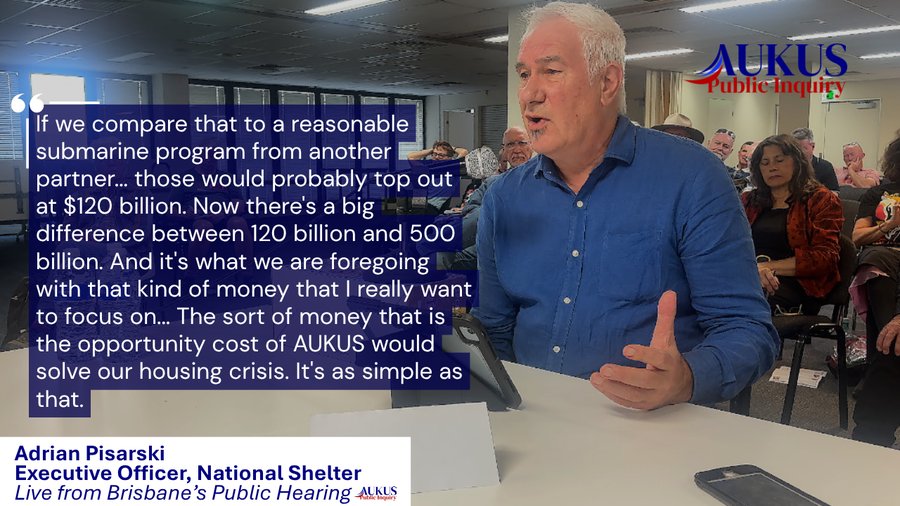
Adrian Pisarski: “That Sort of Money Would Solve Our Housing Crisis”
Executive Officer, National Shelter
“If we compare that to a reasonable submarine program from another partner… those would probably top out at $120 billion. Now there's a big difference between 120 billion and 500 billion. And it's what we are foregoing with that kind of money that I really want to focus on… The sort of money that is the opportunity cost of AUKUS would solve our housing crisis. It's as simple as that.”
Featured Witness
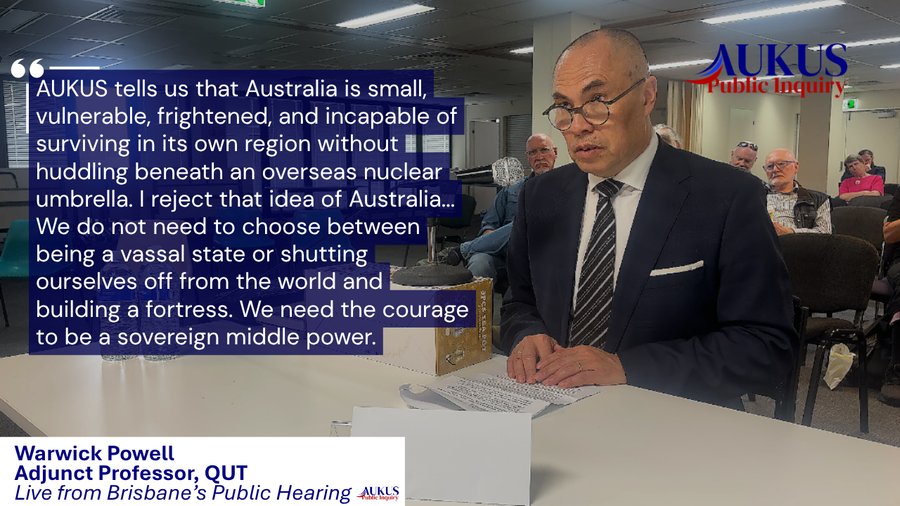
Adjunct Prof Warwick Powell: “AUKUS Is a Mirror Held Up to the Nation”
Adjunct Professor, QUT
“AUKUS tells us that Australia is small, vulnerable, frightened, and incapable of surviving in its own region without huddling beneath an overseas nuclear umbrella. I reject that idea of Australia… We do not need to choose between being a vassal state or shutting ourselves off from the world and building a fortress. We need the courage to be a sovereign middle power.”
Featured Witness
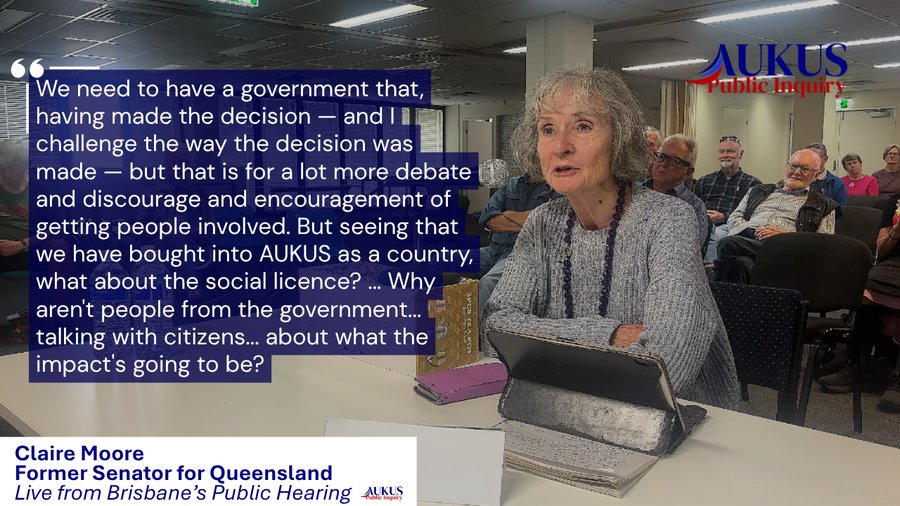
Claire Moore: “Why Aren't People Talking With Citizens About What the Impact's Going to Be?”
Former Senator for Queensland
“We need to have a government that, having made the decision — and I challenge the way the decision was made — but that is for a lot more debate and discourage and encouragement of getting people involved. But seeing that we have bought into AUKUS as a country, what about the social licence? … Why aren't people from the government… talking with citizens… about what the impact's going to be?”
Featured Witness
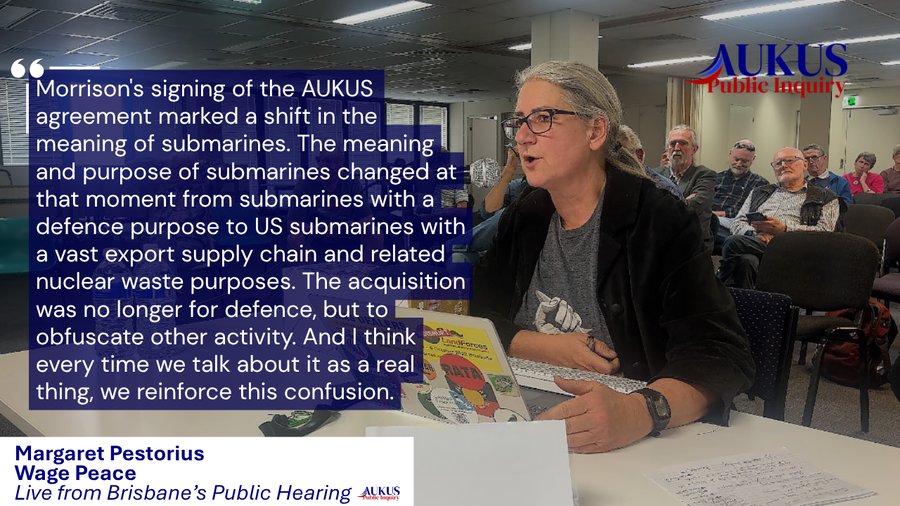
Margaret Pestorius: “AUKUS Is Like a Multi-Billion Dollar Feast”
Wage Peace
“Morrison's signing of the AUKUS agreement marked a shift in the meaning of submarines. The meaning and purpose of submarines changed at that moment from submarines with a defence purpose to US submarines with a vast export supply chain and related nuclear waste purposes. The acquisition was no longer for defence, but to obfuscate other activity. And I think every time we talk about it as a real thing, we reinforce this confusion.”
Featured Witness
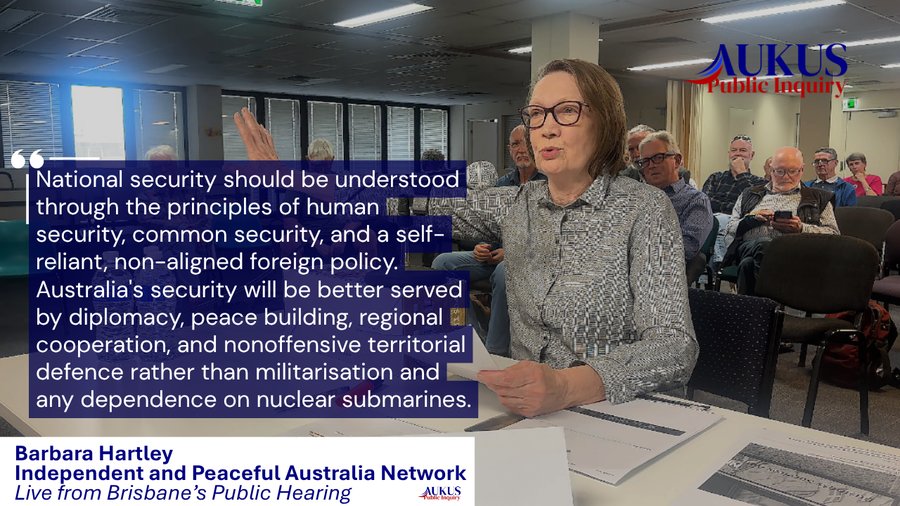
Barbara Hartley: “National Security Should Be Understood Through Human Security”
Independent and Peaceful Australia Network
“National security should be understood through the principles of human security, common security, and a self-reliant, non-aligned foreign policy. Australia's security will be better served by diplomacy, peace building, regional cooperation, and nonoffensive territorial defence rather than militarisation and any dependence on nuclear submarines.”
Featured Witness
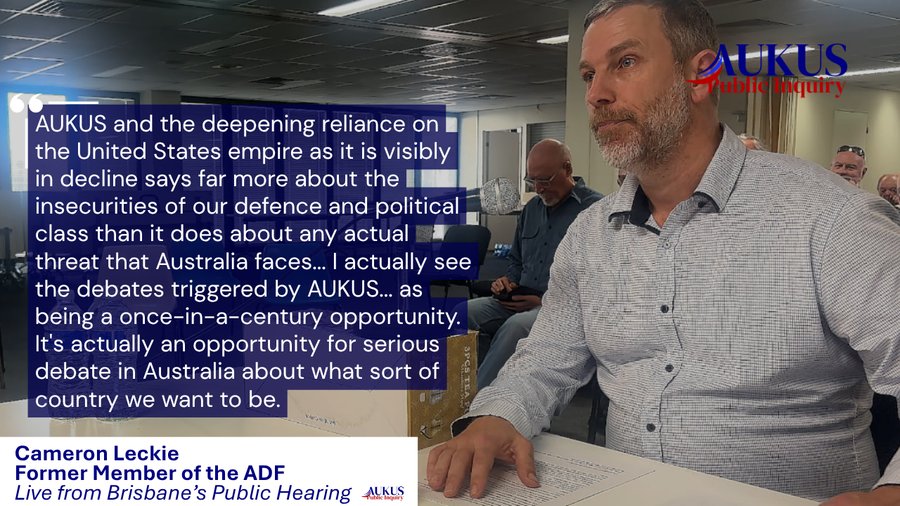
Cameron Leckie: “A Maladaptive Response to the End of the US Empire”
Former Member of the ADF
“AUKUS and the deepening reliance on the United States empire as it is visibly in decline says far more about the insecurities of our defence and political class than it does about any actual threat that Australia faces… I actually see the debates triggered by AUKUS… as being a once-in-a-century opportunity. It's actually an opportunity for serious debate in Australia about what sort of country we want to be.”
Featured Witness
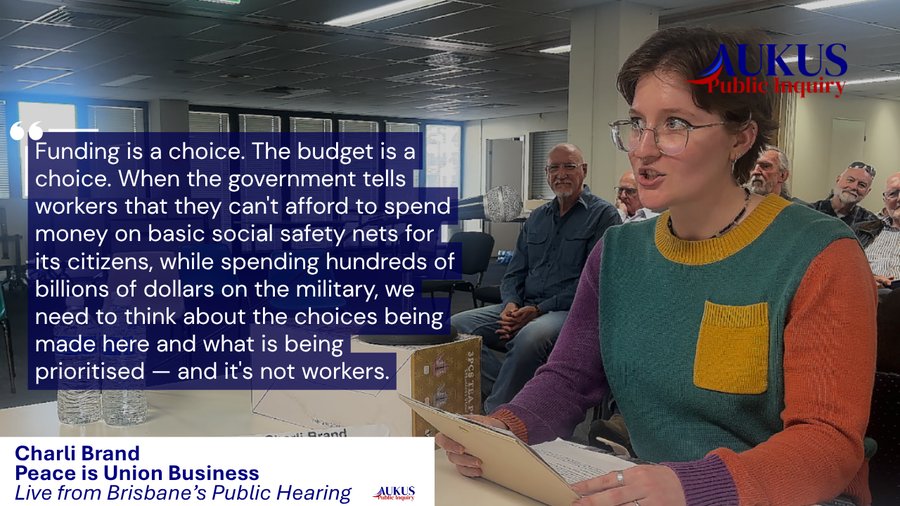
Charli Brand: “$58.99 Billion on the Military. A Mere $1.76 Billion on Diplomacy.”
Peace is Union Business
“Funding is a choice. The budget is a choice. When the government tells workers that they can't afford to spend money on basic social safety nets for its citizens, while spending hundreds of billions of dollars on the military, we need to think about the choices being made here and what is being prioritised — and it's not workers.”
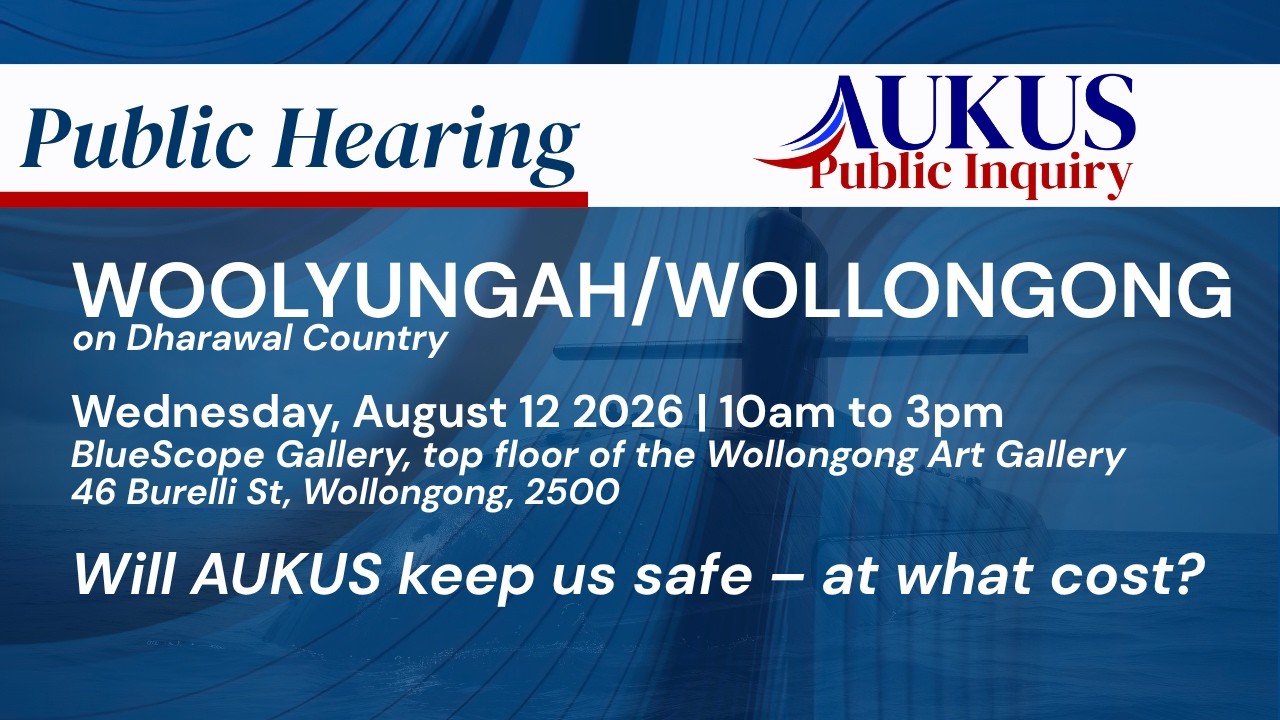
Wollongong — Full Hearing Recording
Wollongong — 12 August 2026
The AUKUS Public Inquiry's hearing in Wollongong brought together union, community, and First Nations voices on the impact of AUKUS on the Illawarra region.
Featured Witness
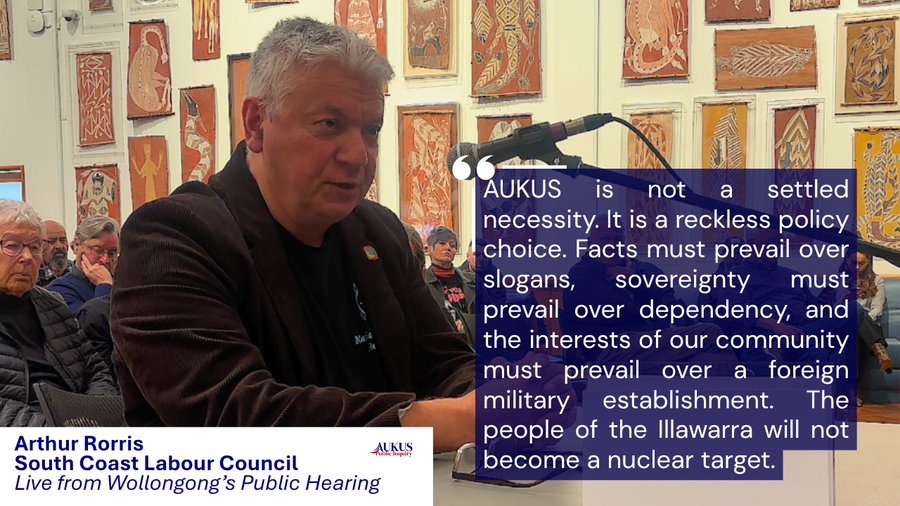
South Coast Labour Council Calls to Rule AUKUS Out
Arthur Rorris, South Coast Labour Council
“AUKUS is not a settled necessity. It is a reckless policy choice. Facts must prevail over slogans, sovereignty must prevail over dependency, and the interests of our community must prevail over a foreign military establishment. The people of the Illawarra will not become a nuclear target.”
Featured Witness
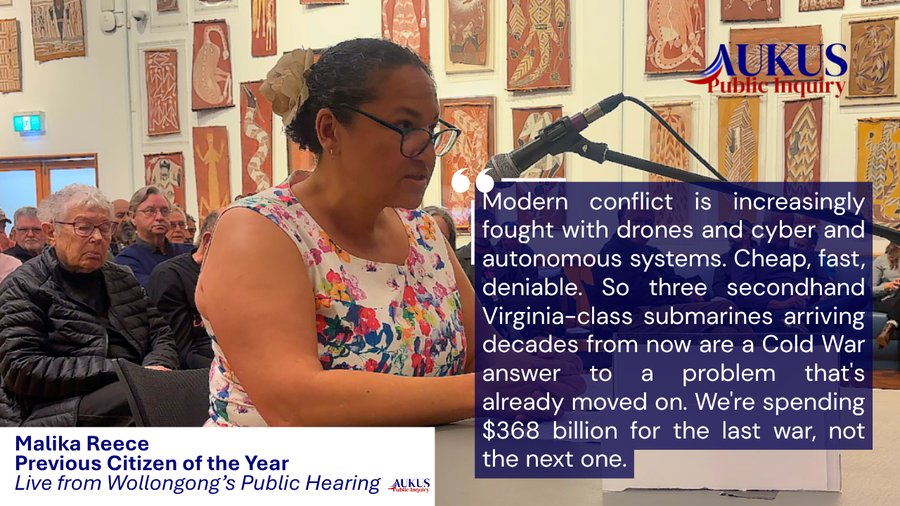
Malika Reece: “A Community That's a Target Isn't More Secure. It's Less.”
Previous Citizen of the Year
“Modern conflict is increasingly fought with drones and cyber and autonomous systems. Cheap, fast, deniable. So three secondhand Virginia-class submarines arriving decades from now are a Cold War answer to a problem that's already moved on. We're spending $368 billion for the last war, not the next one.”
Featured Witness
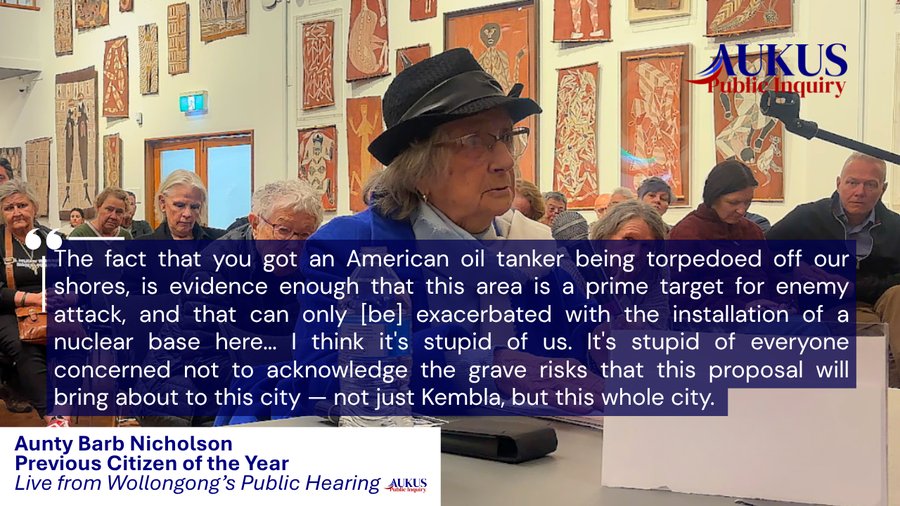
Aunty Barb Nicholson: “This Area Is a Prime Target for Enemy Attack”
Previous Citizen of the Year
“The fact that you got an American oil tanker being torpedoed off our shores, is evidence enough that this area is a prime target for enemy attack, and that can only [be] exacerbated with the installation of a nuclear base here… I think it's stupid of us. It's stupid of everyone concerned not to acknowledge the grave risks that this proposal will bring about to this city — not just Kembla, but this whole city.”
Featured Witness
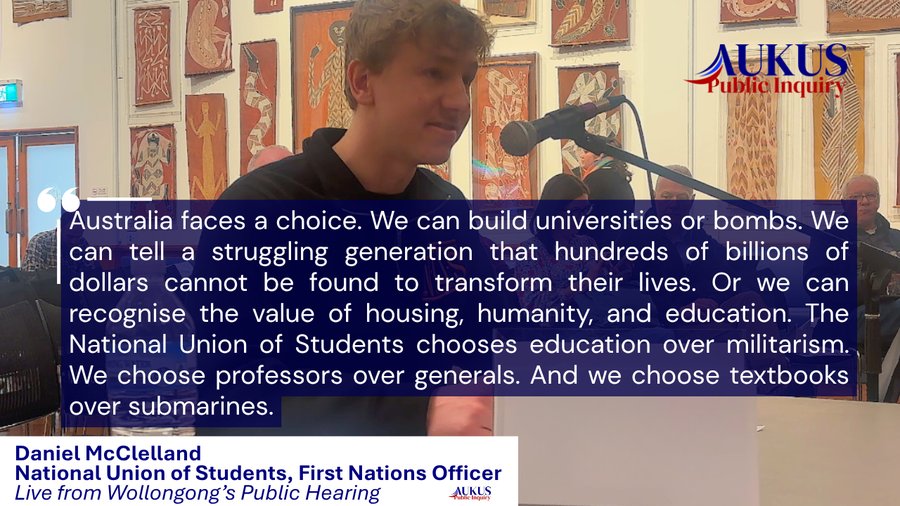
National Union of Students: “We Can Build Universities or Bombs”
Daniel McClelland, National Union of Students, First Nations Officer
“Australia faces a choice. We can build universities or bombs. We can tell a struggling generation that hundreds of billions of dollars cannot be found to transform their lives. Or we can recognise the value of housing, humanity, and education. The National Union of Students chooses education over militarism. We choose professors over generals. And we choose textbooks over submarines.”
Featured Witness
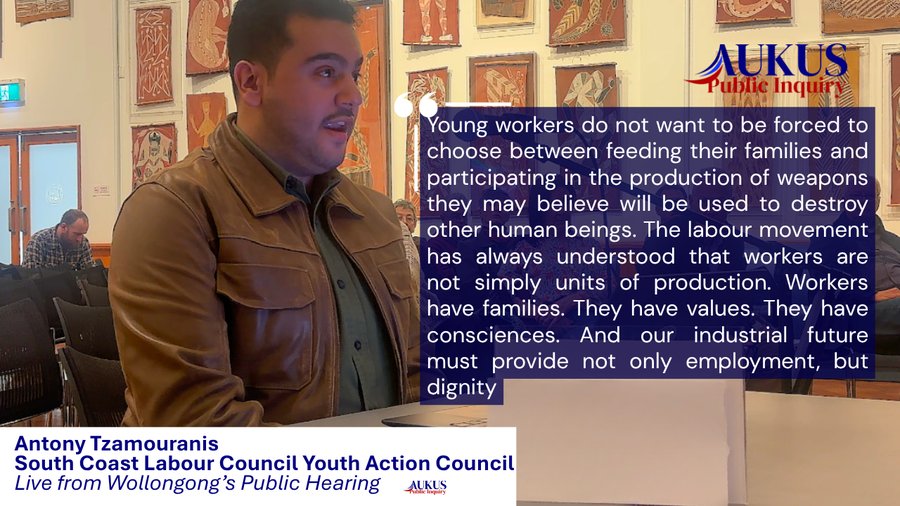
SCLC Youth Action Council: “AUKUS Isn't Preventing the Arms Race. It Is the Arms Race.”
Antony Tzamouranis, South Coast Labour Council Youth Action Council
“Young workers do not want to be forced to choose between feeding their families and participating in the production of weapons they may believe will be used to destroy other human beings. The labour movement has always understood that workers are not simply units of production. Workers have families. They have values. They have consciences. And our industrial future must provide not only employment, but dignity.”
Featured Witness
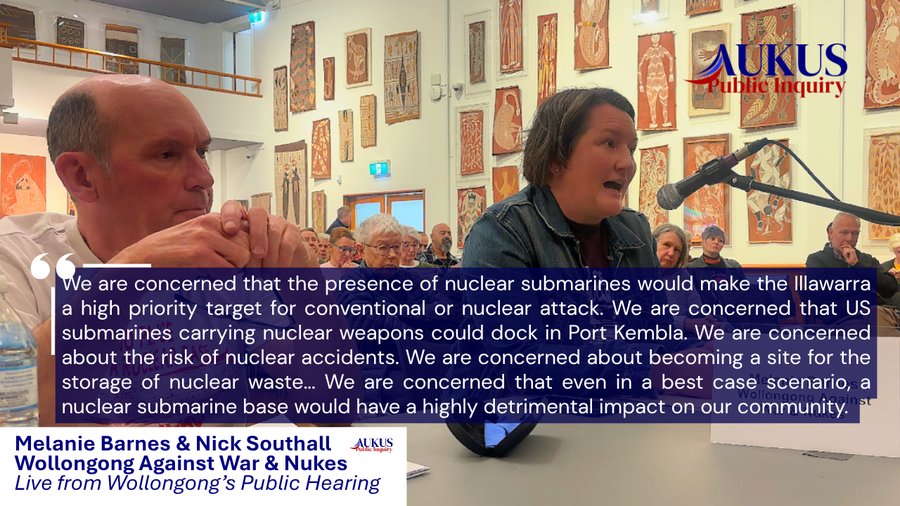
Wollongong Against War and Nukes: “Will AUKUS Keep Us Safe? Our Answer Is No”
Melanie Barnes & Nick Southall, Wollongong Against War & Nukes
“We are concerned that the presence of nuclear submarines would make the Illawarra a high priority target for conventional or nuclear attack. We are concerned that US submarines carrying nuclear weapons could dock in Port Kembla. We are concerned about the risk of nuclear accidents. We are concerned about becoming a site for the storage of nuclear waste… We are concerned that even in a best case scenario, a nuclear submarine base would have a highly detrimental impact on our community.”
Featured Witness
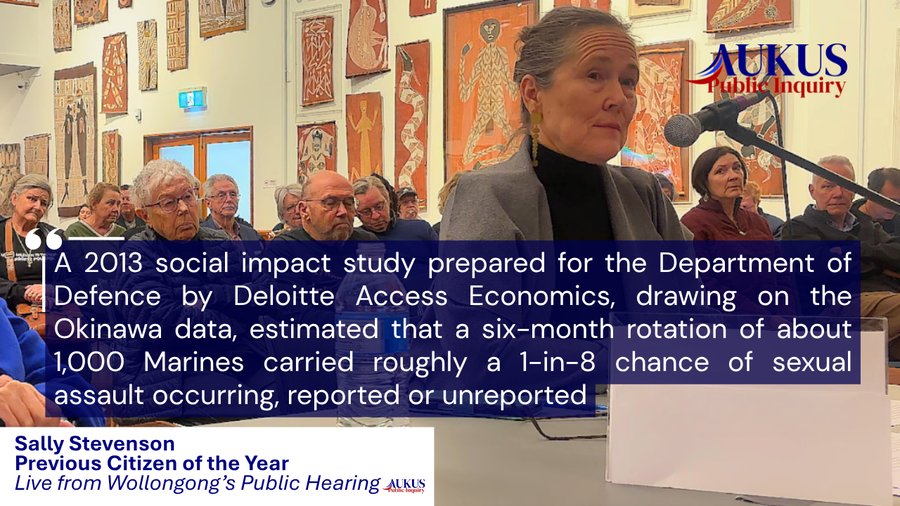
Sally Stevenson: “Women Will Pay the Silent Price of AUKUS”
Previous Citizen of the Year
“A 2013 social impact study prepared for the Department of Defence by Deloitte Access Economics, drawing on the Okinawa data, estimated that a six-month rotation of about 1,000 Marines carried roughly a 1-in-8 chance of sexual assault occurring, reported or unreported.”
Featured Witness
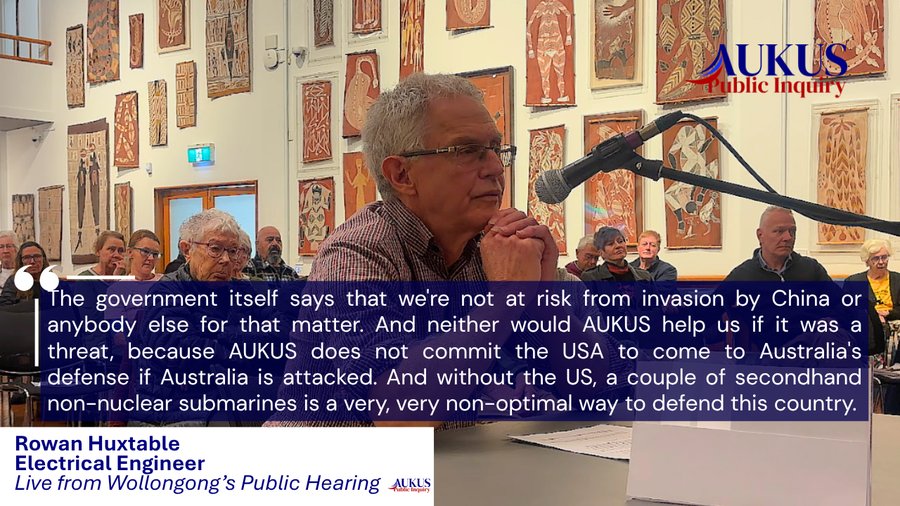
Rowan Huxtable Calls AUKUS “An Appalling Failure of the Government's Duty to Apply Due Diligence”
Electrical Engineer
“The government itself says that we're not at risk from invasion by China or anybody else for that matter. And neither would AUKUS help us if it was a threat, because AUKUS does not commit the USA to come to Australia's defense if Australia is attacked. And without the US, a couple of secondhand non-nuclear submarines is a very, very non-optimal way to defend this country.”
Featured Witness
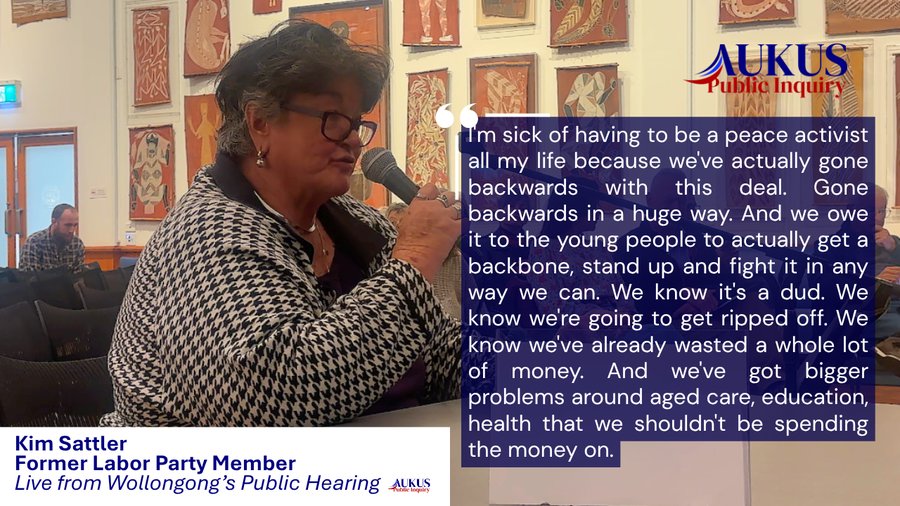
Kim Sattler: “We Owe It to the Young People to Actually Get a Backbone”
Former Long-Term Labor Party Member
“I'm sick of having to be a peace activist all my life because we've actually gone backwards with this deal. Gone backwards in a huge way. And we owe it to the young people to actually get a backbone, stand up and fight it in any way we can. We know it's a dud. We know we're going to get ripped off. We know we've already wasted a whole lot of money. And we've got bigger problems around aged care, education, health that we shouldn't be spending the money on.”
Newcastle — Full Hearing Recording
Newcastle — 11 August 2026
The AUKUS Public Inquiry's hearing in Newcastle brought together community, faith, education, and local government voices on the impact of AUKUS on the Hunter region.
Featured Witness
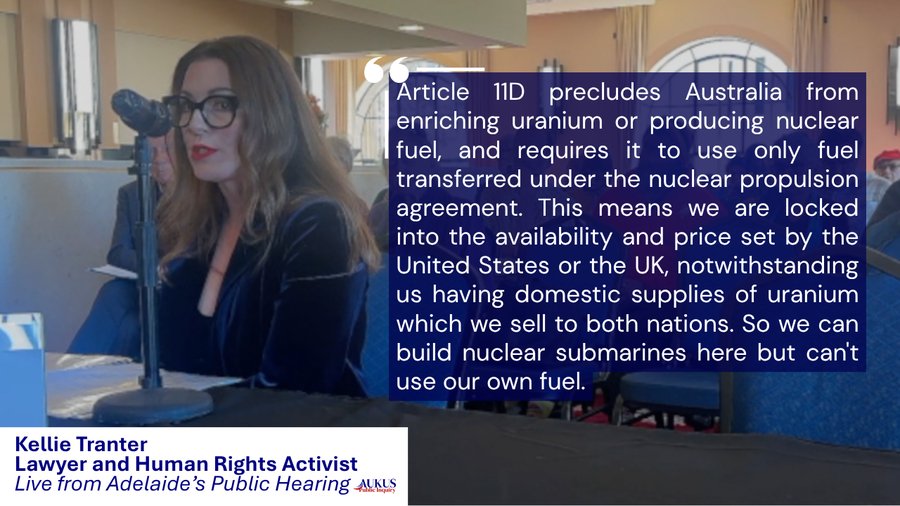
Kellie Tranter: “More Money Than There Are Stars in the Milky Way”
Lawyer and Human Rights Activist
“Article 11D precludes Australia from enriching uranium or producing nuclear fuel, and requires it to use only fuel transferred under the nuclear propulsion agreement. This means we are locked into the availability and price set by the United States or the UK, notwithstanding us having domestic supplies of uranium which we sell to both nations. So we can build nuclear submarines here but can't use our own fuel.”
Featured Witness
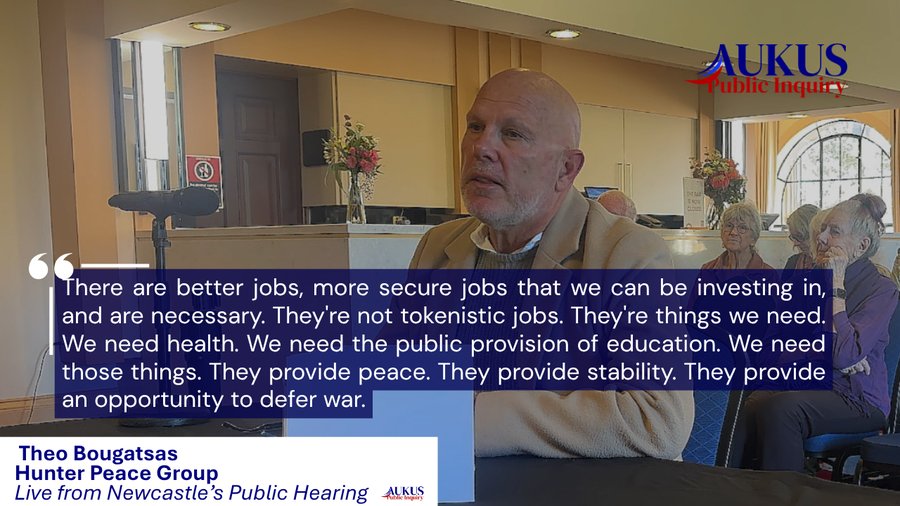
Theo Bougatsas: “The First Victims of War Are Always Children. Always.”
Hunter Peace Group
“There are better jobs, more secure jobs that we can be investing in, and are necessary. They're not tokenistic jobs. They're things we need. We need health. We need the public provision of education. We need those things. They provide peace. They provide stability. They provide an opportunity to defer war.”
Featured Witness
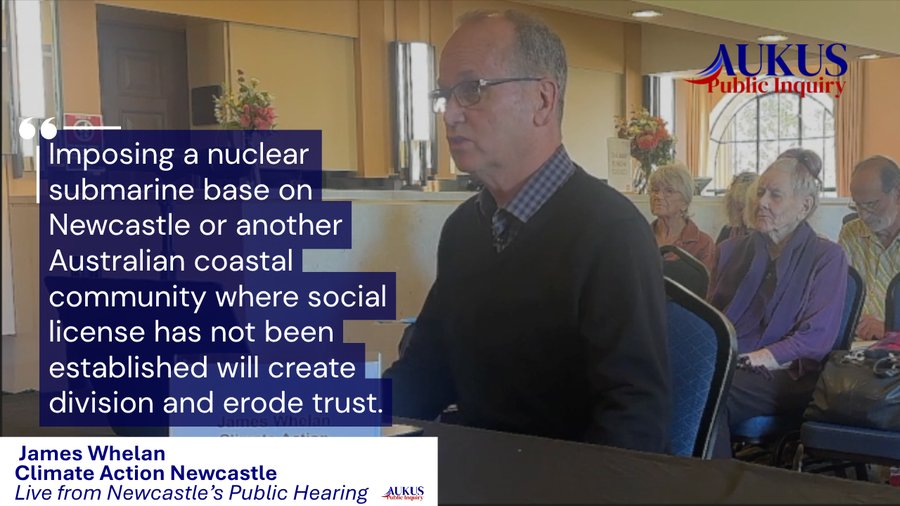
James Whelan: “Australian Voters Are Not Willing to Accept the Impacts and Risks of Nuclear Power”
Climate Action Newcastle
“Imposing a nuclear submarine base on Newcastle or another Australian coastal community where social license has not been established will create division and erode trust.”
Featured Witness
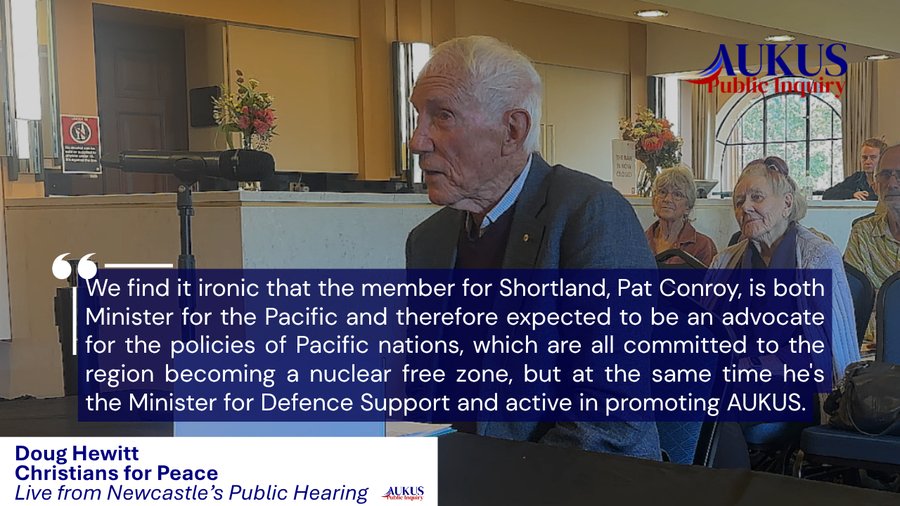
Doug Hewitt: “Every Gun That Is Made Signifies the Theft of Food From the Hungry”
Christians for Peace
“We find it ironic that the member for Shortland, Pat Conroy, is both Minister for the Pacific and therefore expected to be an advocate for the policies of Pacific nations, which are all committed to the region becoming a nuclear free zone, but at the same time he's the Minister for Defence Support and active in promoting AUKUS.”
Featured Witness
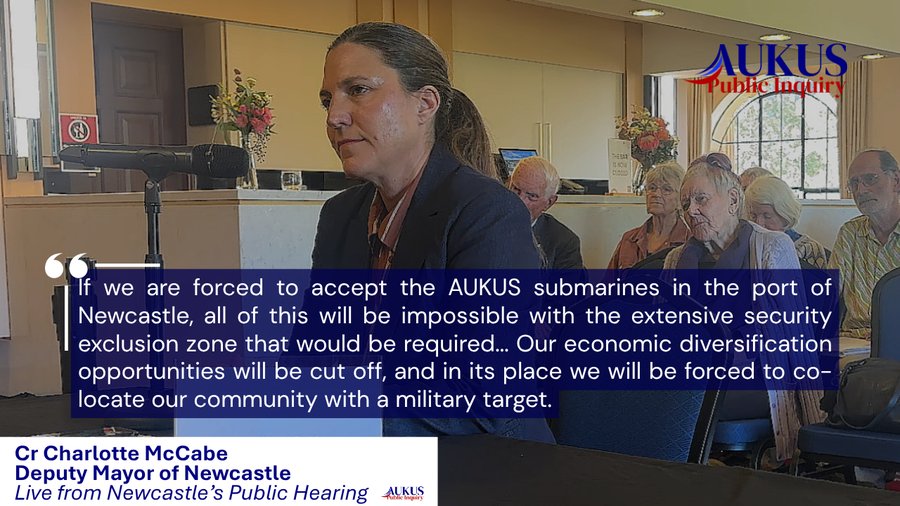
Cr Charlotte McCabe: “Our Silence Is Being Treated as Consent”
Deputy Mayor of Newcastle
“If we are forced to accept the AUKUS submarines in the port of Newcastle, all of this will be impossible with the extensive security exclusion zone that would be required… Our economic diversification opportunities will be cut off, and in its place we will be forced to co-locate our community with a military target.”
Featured Witness
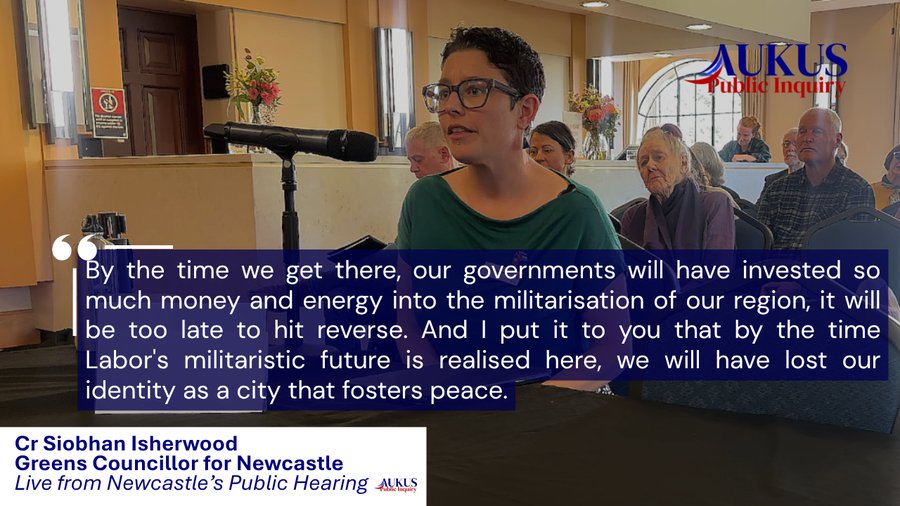
Cr Siobhan Isherwood: “With No Consultation, No Conversation, No Cabinet Brief”
Greens Councillor for Newcastle
“By the time we get there, our governments will have invested so much money and energy into the militarisation of our region, it will be too late to hit reverse. And I put it to you that by the time Labor's militaristic future is realised here, we will have lost our identity as a city that fosters peace.”
Featured Witness
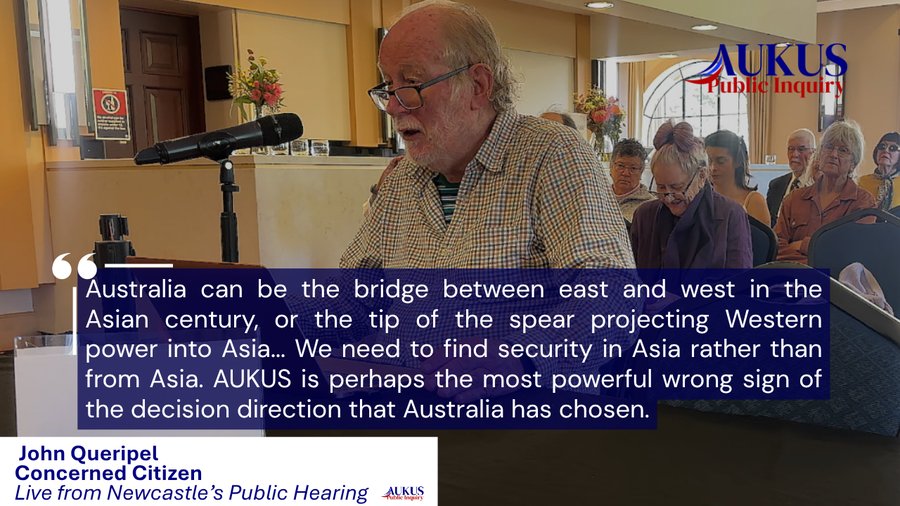
John Queripel: “The Wrong Weapon for the Wrong Purpose at the Wrong Cost”
Concerned Citizen
“Australia can be the bridge between east and west in the Asian century, or the tip of the spear projecting Western power into Asia… We need to find security in Asia rather than from Asia. AUKUS is perhaps the most powerful wrong sign of the decision direction that Australia has chosen.”
Featured Witness
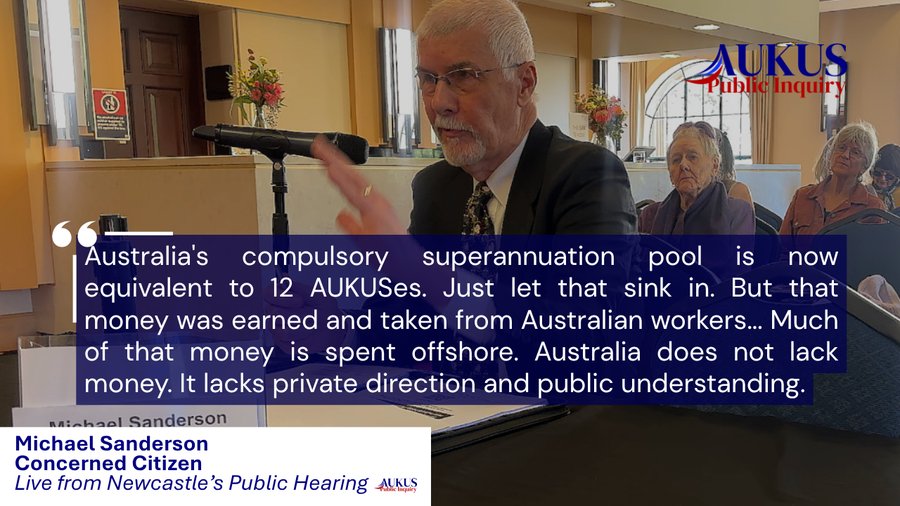
Michael Sanderson: “Australia's Compulsory Superannuation Pool Is Now Equivalent to 12 AUKUSes”
Concerned Citizen
“Australia's compulsory superannuation pool is now equivalent to 12 AUKUSes. Just let that sink in. But that money was earned and taken from Australian workers… Much of that money is spent offshore. Australia does not lack money. It lacks private direction and public understanding.”
Featured Witness
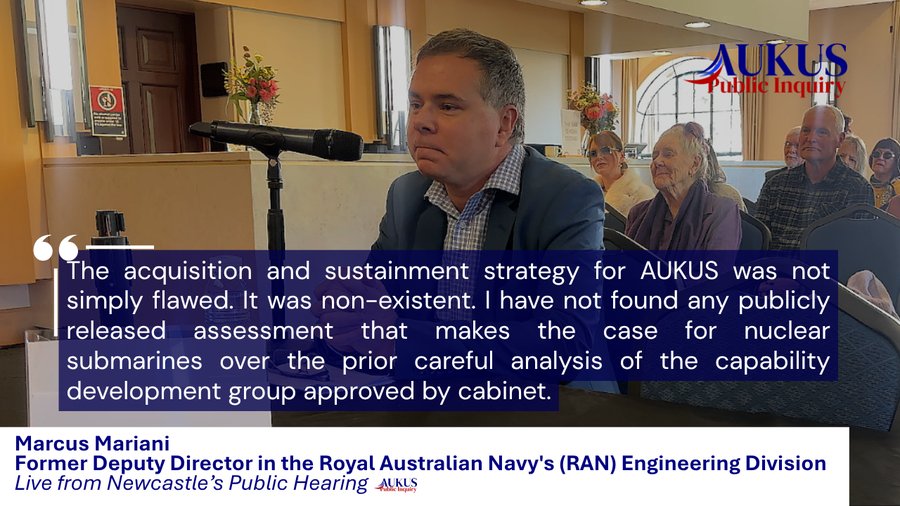
Marcus Mariani: “To Be an Enemy of the United States Is Dangerous, But to Be a Friend Is Fatal”
Former Deputy Director, Royal Australian Navy's (RAN) Engineering Division
“The acquisition and sustainment strategy for AUKUS was not simply flawed. It was non-existent. I have not found any publicly released assessment that makes the case for nuclear submarines over the prior careful analysis of the capability development group approved by cabinet.”
Featured Witness
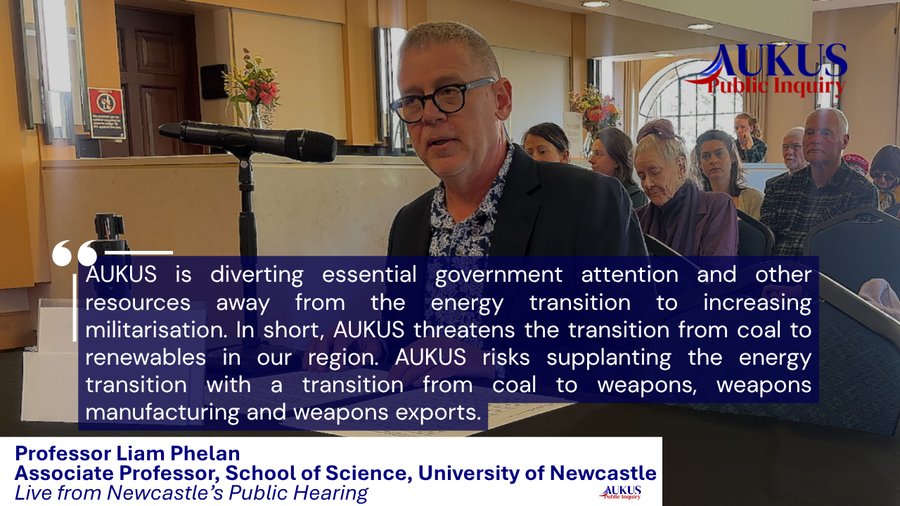
Prof Liam Phelan Says AUKUS “Is Morally Reprehensible”
Associate Professor, School of Science, University of Newcastle
“AUKUS is diverting essential government attention and other resources away from the energy transition to increasing militarisation. In short, AUKUS threatens the transition from coal to renewables in our region. AUKUS risks supplanting the energy transition with a transition from coal to weapons, weapons manufacturing and weapons exports.”
Sydney — Full Hearing Recording
Sydney — 10 August 2026
The AUKUS Public Inquiry's hearing in Sydney brought together former political leaders, unions, students, and community voices at NSW Parliament House.
Featured Witness
The Hon Malcolm Turnbull on AUKUS: “It's Not Called a US Base, But It Is a US Base”
29th Prime Minister of Australia
The Hon. Malcolm Turnbull AC told the Sydney hearing that Australia is bearing the greatest financial cost and risk of the three AUKUS partners while remaining the least informed about the arrangement's true terms and implications.
“We're writing the cheques. We're taking the most risk. But we are the least curious and the least informed. And whether you like AUKUS or not — that is a disgrace.”
Featured Witness
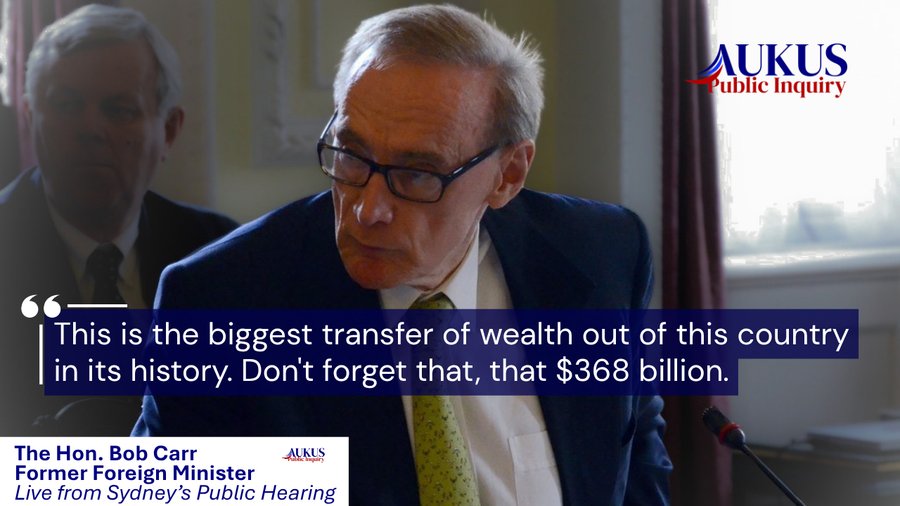
The Hon. Bob Carr: “The Biggest Transfer of Wealth Out of This Country in Its History”
Former Foreign Minister
“This is the biggest transfer of wealth out of this country in its history. Don't forget that, that $368 billion.”
Featured Witness
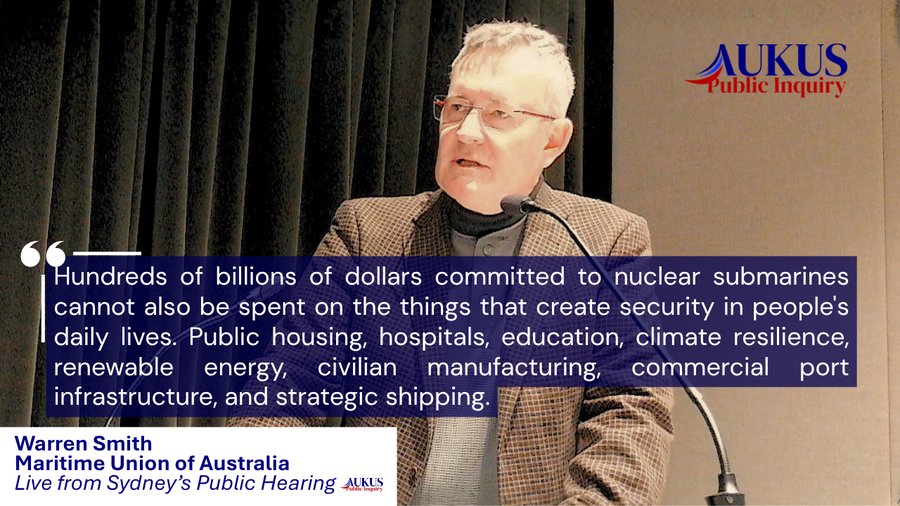
Maritime Union of Australia: “Australia Needs Jobs and Health, Not Nukes”
Warren Smith, Maritime Union of Australia
“Hundreds of billions of dollars committed to nuclear submarines cannot also be spent on the things that create security in people's daily lives. Public housing, hospitals, education, climate resilience, renewable energy, civilian manufacturing, commercial port infrastructure, and strategic shipping.”
Featured Witness
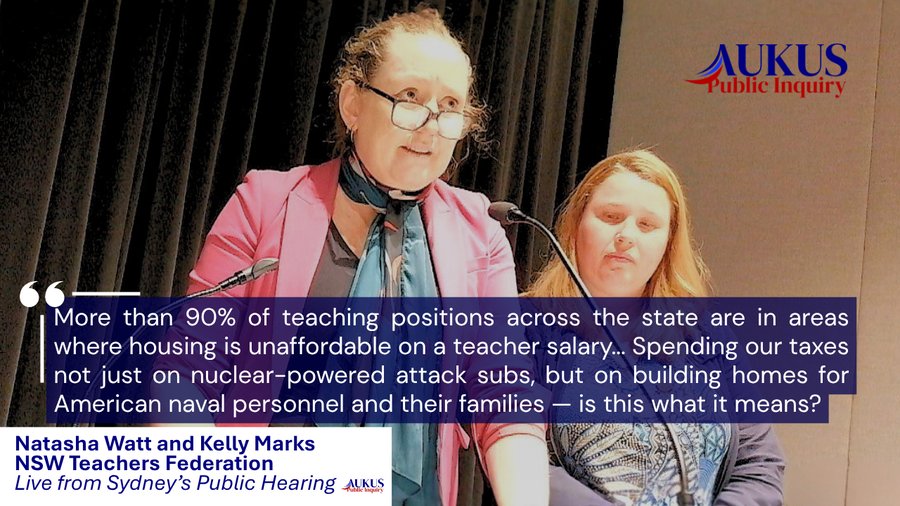
NSW Teachers Federation: “A $368 Billion Disgrace That Benefits Nobody But the United States”
Natasha Watt and Kelly Marks, NSW Teachers Federation
“More than 90% of teaching positions across the state are in areas where housing is unaffordable on a teacher salary… Spending our taxes not just on nuclear-powered attack subs, but on building homes for American naval personnel and their families — is this what it means?”
Featured Witness
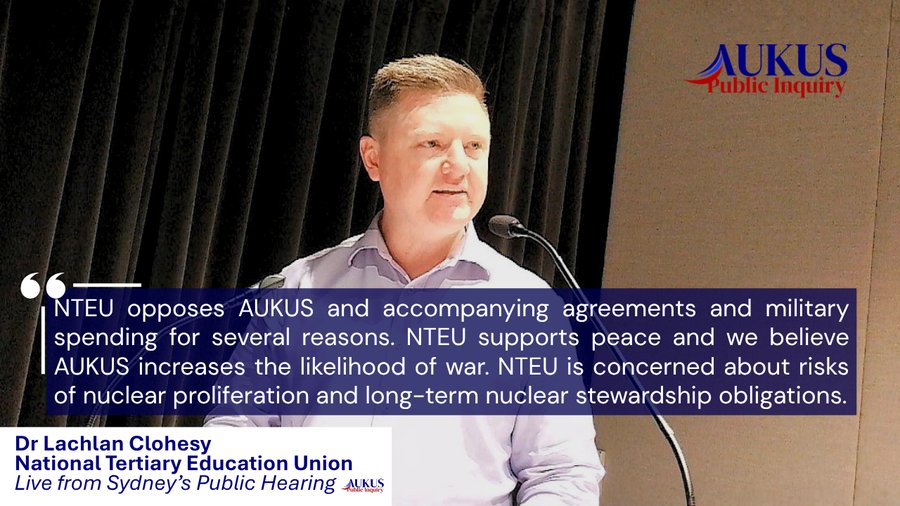
NTEU: “Universities Are Pitching Themselves for AUKUS Money”
Dr Lachlan Clohesy, National Tertiary Education Union
“NTEU opposes AUKUS and accompanying agreements and military spending for several reasons. NTEU supports peace and we believe AUKUS increases the likelihood of war. NTEU is concerned about risks of nuclear proliferation and long-term nuclear stewardship obligations.”
Featured Witness
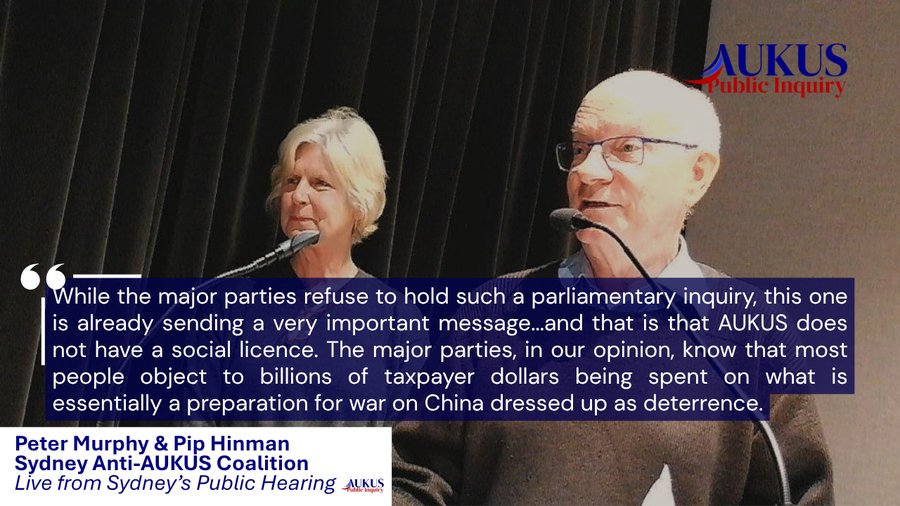
Sydney Anti-AUKUS Coalition: “AUKUS Does Not Have a Social Licence”
Peter Murphy and Pip Hinman, Sydney Anti-AUKUS Coalition
“While the major parties refuse to hold such a parliamentary inquiry, this one is already sending a very important message…and that is that AUKUS does not have a social licence. The major parties, in our opinion, know that most people object to billions of taxpayer dollars being spent on what is essentially a preparation for war on China dressed up as deterrence.”
Featured Witness
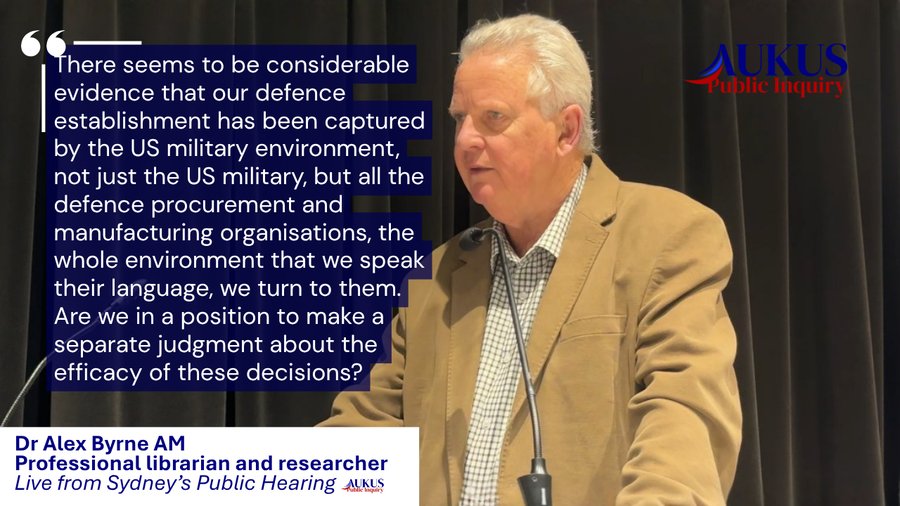
Dr Alex Byrne AM Says AUKUS Is “The Same Cost as World War II”
Professional Librarian and Researcher
“There seems to be considerable evidence that our defence establishment has been captured by the US military environment, not just the US military, but all the defence procurement and manufacturing organisations, the whole environment that we speak their language, we turn to them. Are we in a position to make a separate judgment about the efficacy of these decisions?”
Featured Witness
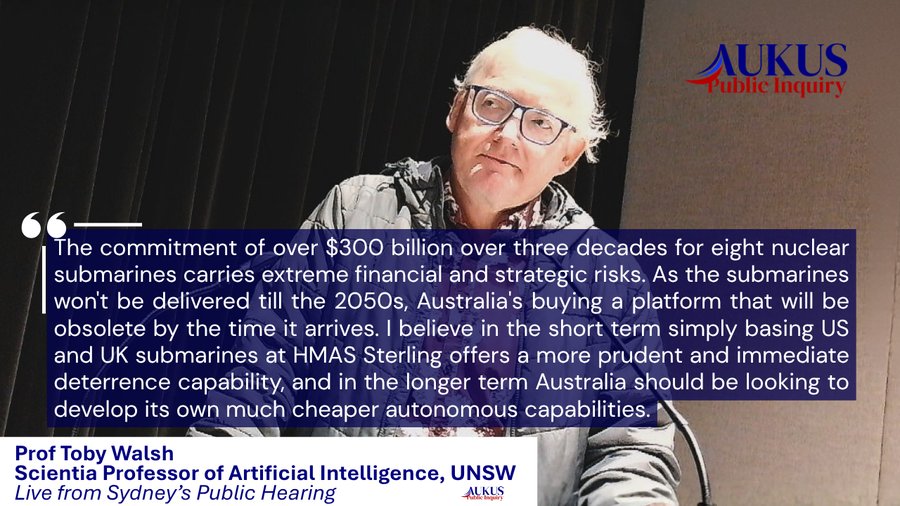
Prof Toby Walsh Says AUKUS Is “A Platform That Will Be Obsolete by the Time It Arrives”
Scientia Professor of Artificial Intelligence, UNSW
“The commitment of over $300 billion over three decades for eight nuclear submarines carries extreme financial and strategic risks. As the submarines won't be delivered till the 2050s, Australia's buying a platform that will be obsolete by the time it arrives. I believe in the short term simply basing US and UK submarines at HMAS Sterling offers a more prudent and immediate deterrence capability, and in the longer term Australia should be looking to develop its own much cheaper autonomous capabilities.”
Featured Witness
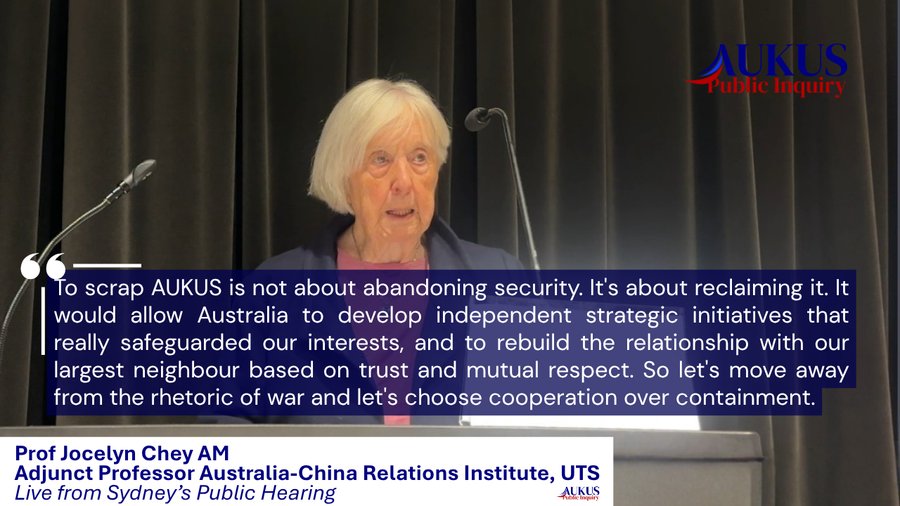
Prof Jocelyn Chey: “Without Any Reservations, I Think AUKUS Should Be Scrapped”
Adjunct Professor, Australia-China Relations Institute, UTS
“To scrap AUKUS is not about abandoning security. It's about reclaiming it. It would allow Australia to develop independent strategic initiatives that really safeguarded our interests, and to rebuild the relationship with our largest neighbour based on trust and mutual respect. So let's move away from the rhetoric of war and let's choose cooperation over containment.”
Featured Witness
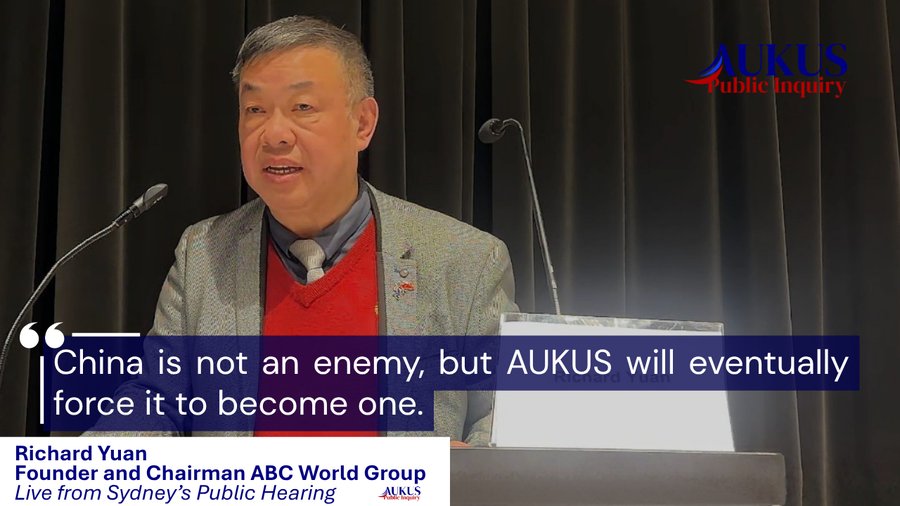
Richard Yuan: “China Is Not an Enemy, But AUKUS Will Eventually Force It to Become One”
Founder and Chairman, ABC World Group
“China is not an enemy, but AUKUS will eventually force it to become one.”
Featured Witness
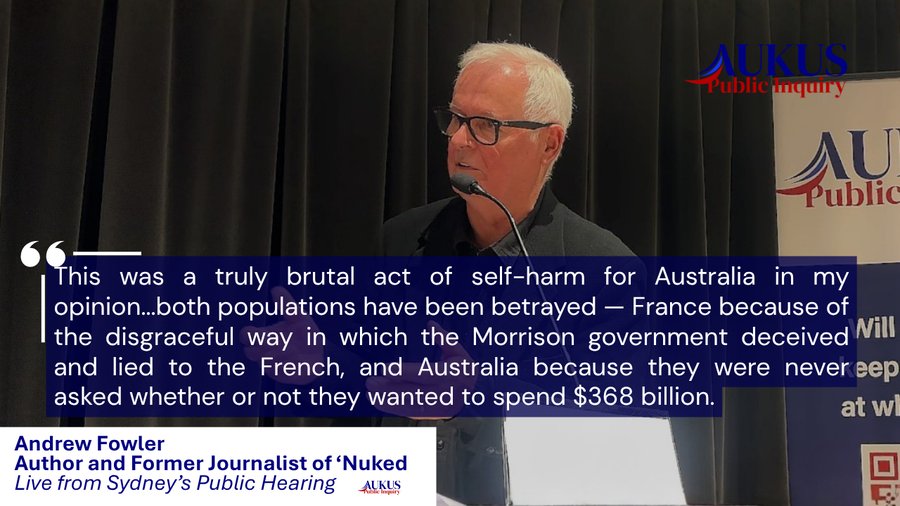
Andrew Fowler Says AUKUS Is “A Truly Brutal Act of Self-Harm for Australia”
Author and Former Journalist of ‘Nuked’
“This was a truly brutal act of self-harm for Australia in my opinion…both populations have been betrayed — France because of the disgraceful way in which the Morrison government deceived and lied to the French, and Australia because they were never asked whether or not they wanted to spend $368 billion.”
Featured Witness
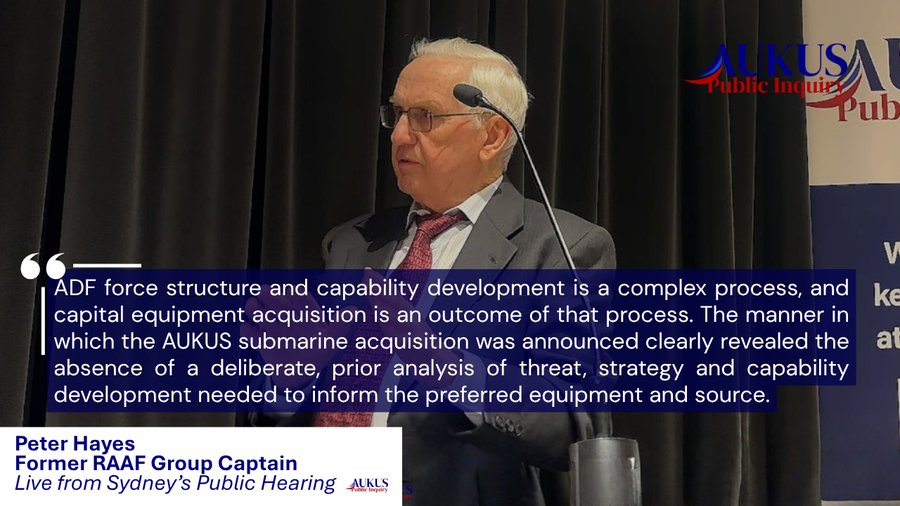
Peter Hayes: “I Do Not Support This Acquisition Without Prior Validation”
Former RAAF Group Captain
“ADF force structure and capability development is a complex process, and capital equipment acquisition is an outcome of that process. The manner in which the AUKUS submarine acquisition was announced clearly revealed the absence of a deliberate, prior analysis of threat, strategy and capability development needed to inform the preferred equipment and source.”
Featured Witness
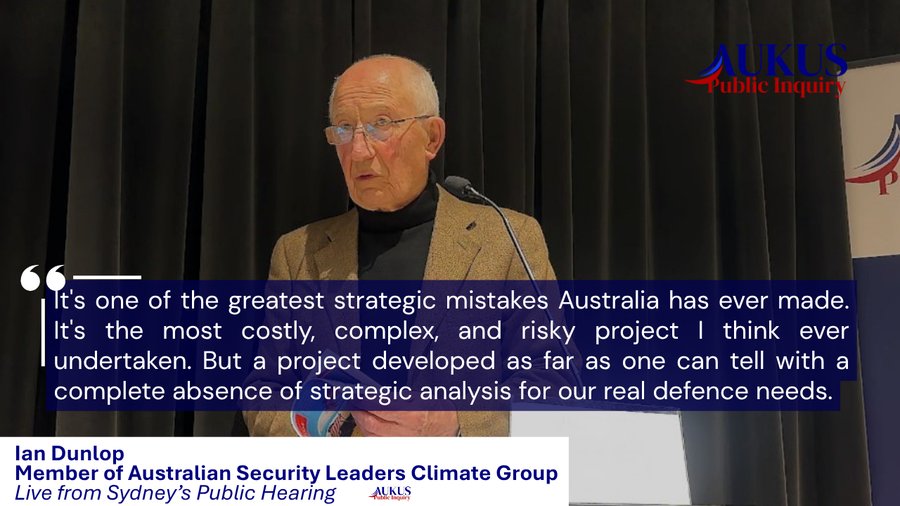
Ian Dunlop Says AUKUS Is “One of the Greatest Strategic Mistakes Australia Has Ever Made”
Member of Australian Security Leaders Climate Group
“It's one of the greatest strategic mistakes Australia has ever made. It's the most costly, complex, and risky project I think ever undertaken. But a project developed as far as one can tell with a complete absence of strategic analysis for our real defence needs.”
Tarndanya / Adelaide — Full Hearing Livestream
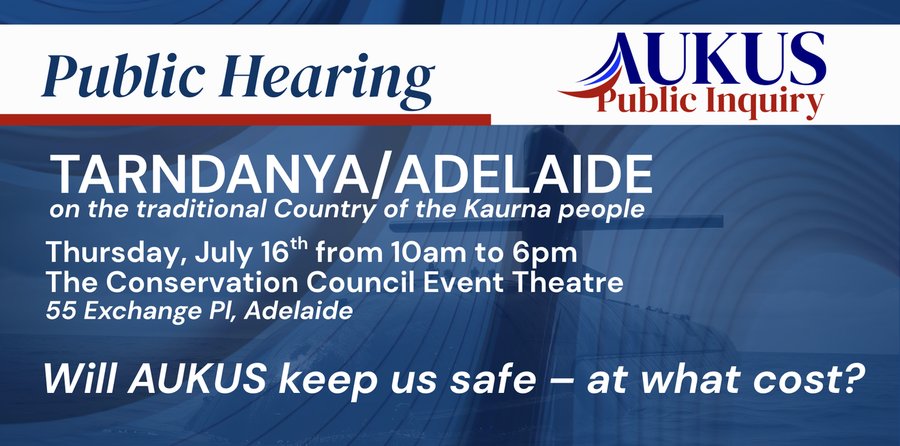
Tarndanya / Adelaide — 16 July 2026
The third public hearing of the AUKUS Public Inquiry was held on the traditional Country of the Kaurna people, at the Conservation Council of South Australia's Event Theatre, followed by a dedicated First Nations Yarn the next day.
Featured Witness
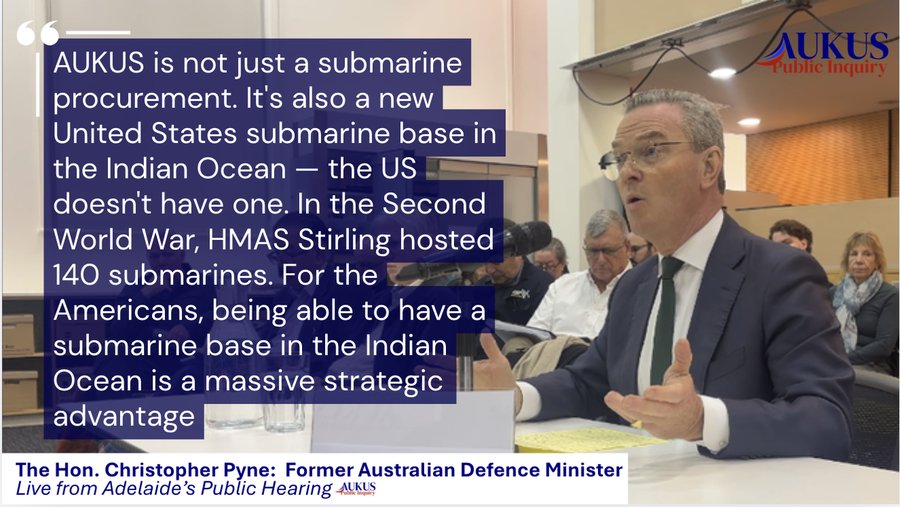
Christopher Pyne: Why AUKUS is worth the cost and the delays
Former Australian Defence Minister; Strategic Advisor, Lobbyist and Company Director, Pyne & Partners
“AUKUS is not just a submarine procurement. It's also a new United States submarine base in the Indian Ocean — the US doesn't have one. In the Second World War, HMAS Stirling hosted 140 submarines. For the Americans, being able to have a submarine base in the Indian Ocean is a massive strategic advantage.”
Featured Witness
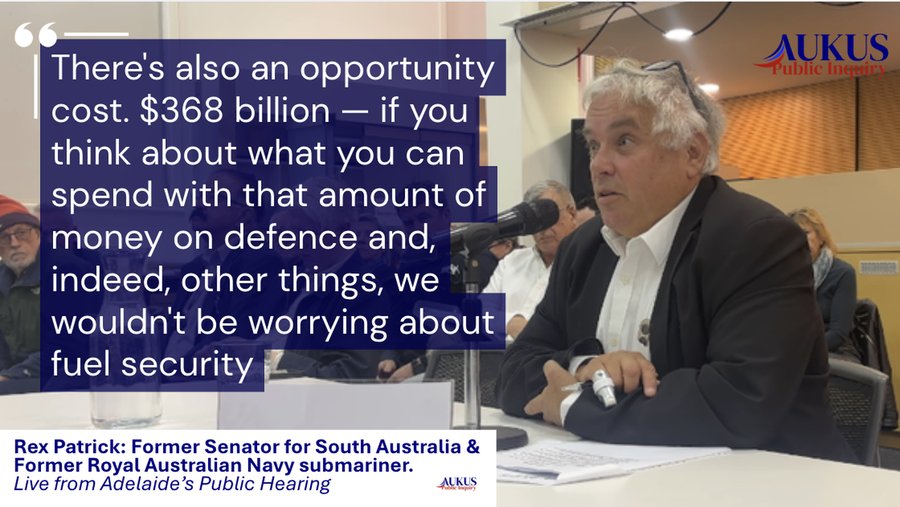
Rex Patrick: “We’re staring at a serious capability gap”
Former Senator for South Australia (2017–2022); Former Royal Australian Navy Submariner; Transparency Advocate
“There's also an opportunity cost. $368 billion — if you think about what you can spend with that amount of money on defence and, indeed, other things, we wouldn't be worrying about fuel security.”
Featured Witness
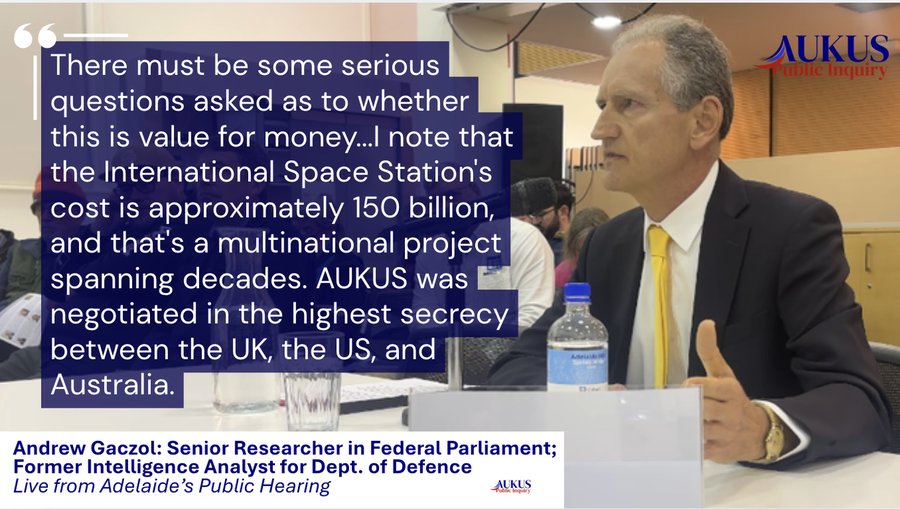
Andrew Gaczol: “AUKUS Pillar One is a delusion”
Senior Researcher in Federal Parliament; Former Intelligence Analyst, Department of Defence
“There must be some serious questions asked as to whether this is value for money…I note that the International Space Station's cost is approximately 150 billion, and that's a multinational project spanning decades. AUKUS was negotiated in the highest secrecy between the UK, the US, and Australia.”
Featured Witness
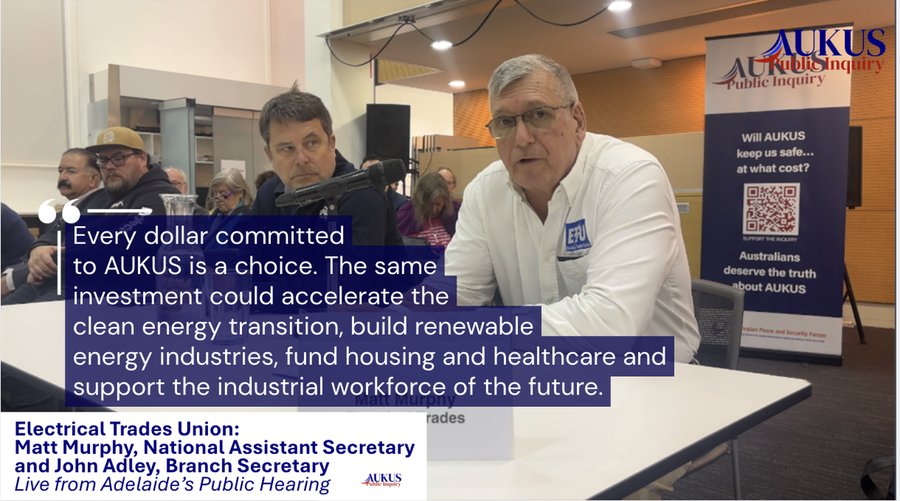
ETU: “Australians are being asked to pay more and accept less”
Matt Murphy, National Assistant Secretary; John Adley, Branch Secretary — Electrical Trades Union
“Every dollar committed to AUKUS is a choice. The same investment could accelerate the clean energy transition, build renewable energy industries, fund housing and healthcare and support the industrial workforce of the future.”
Featured Witness
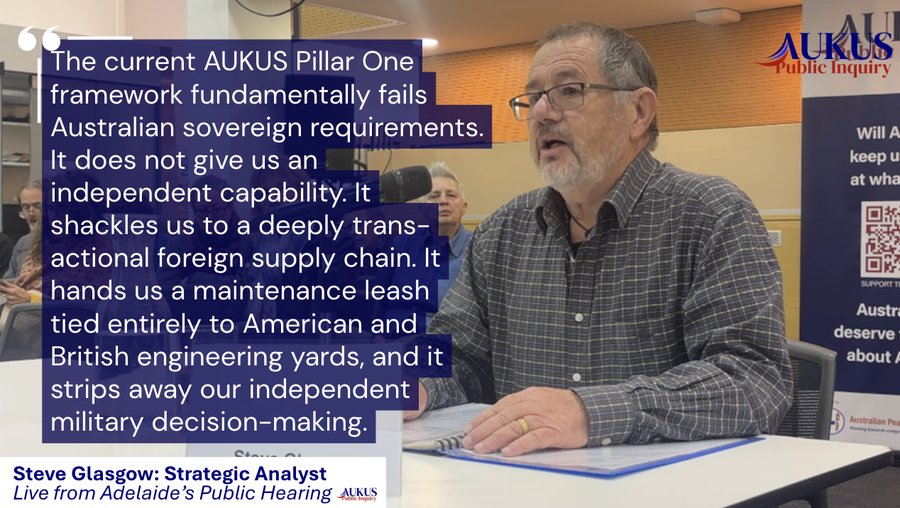
Steve Glasgow: “You cannot guard Australia with legacy steel”
Strategic Analyst
“The current AUKUS Pillar One framework fundamentally fails Australian sovereign requirements. It does not give us an independent capability. It shackles us to a deeply transactional foreign supply chain. It hands us a maintenance leash tied entirely to American and British engineering yards, and it strips away our independent military decision-making.”
Featured Witness
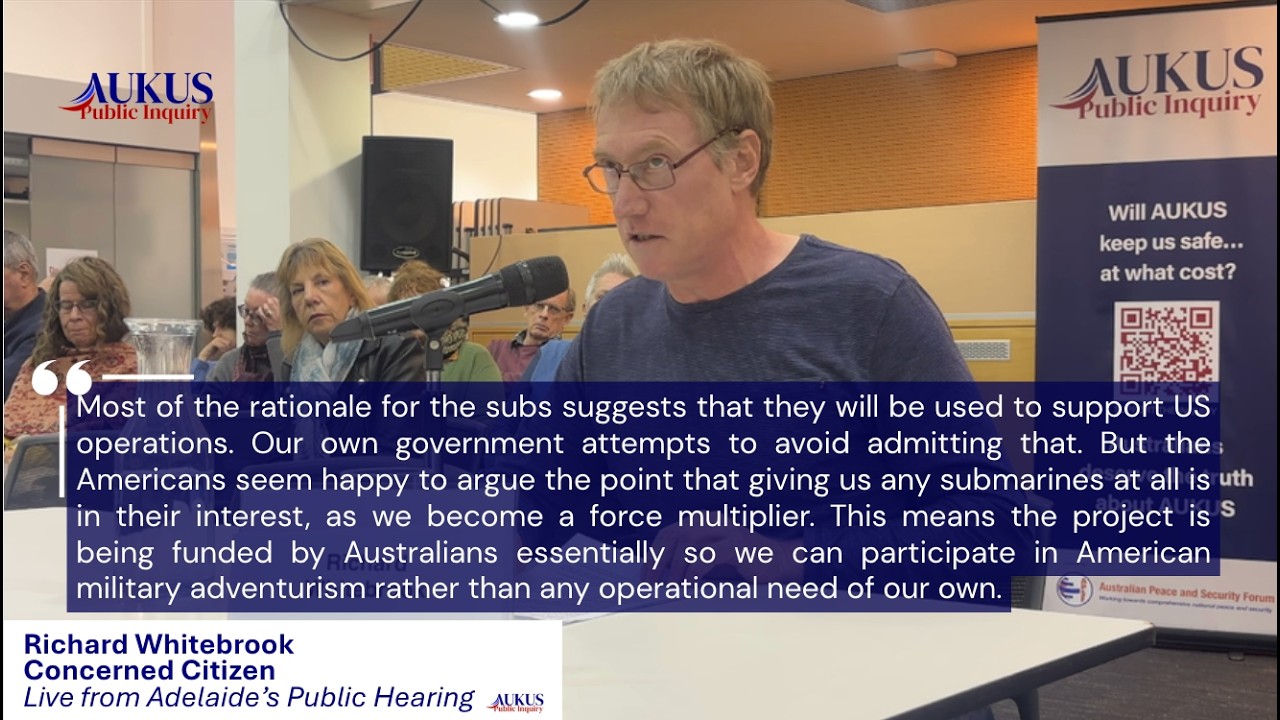
Richard Whitebrook: “We Spend $368 Billion, Maybe, and We Get Three Used Subs”
Concerned Citizen
“Most of the rationale for the subs suggests that they will be used to support US operations. Our own government attempts to avoid admitting that. But the Americans seem happy to argue the point that giving us any submarines at all is in their interest, as we become a force multiplier. This means the project is being funded by Australians essentially so we can participate in American military adventurism rather than any operational need of our own.”
Featured Witness
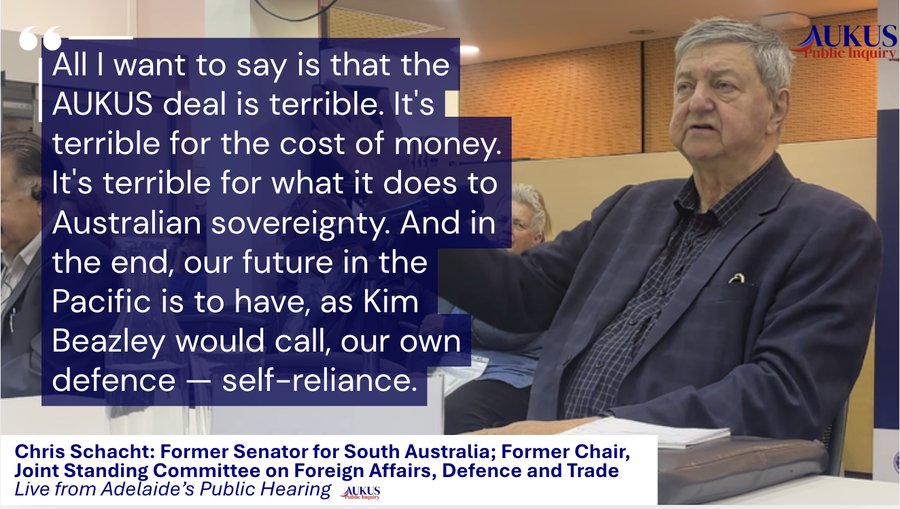
Chris Schacht says “The AUKUS deal is terrible”
Former Senator for South Australia and Former Minister in the Keating Government; Former Chair, Joint Standing Committee on Foreign Affairs, Defence and Trade
“All I want to say is that the AUKUS deal is terrible. It's terrible for the cost of money. It's terrible for what it does to Australian sovereignty. And in the end, our future in the Pacific is to have, as Kim Beazley would call, our own defence — self-reliance.”
Featured Witness
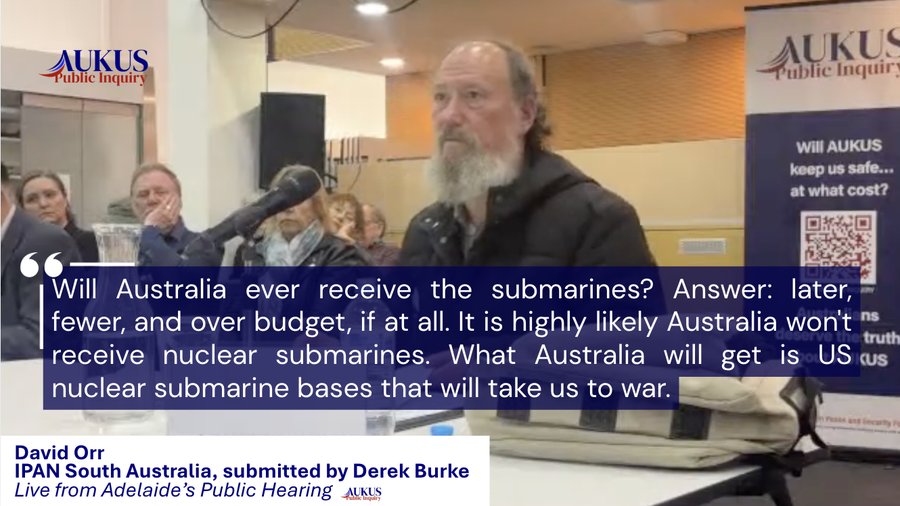
David Orr: “AUKUS Has Turned Out to Be a Trojan Horse”
Independent and Peaceful Australia Network – South Australia (IPAN-SA)
“Will Australia ever receive the submarines? Answer: later, fewer, and over budget, if at all. It is highly likely Australia won't receive nuclear submarines. What Australia will get is US nuclear submarine bases that will take us to war.”
Featured Witness
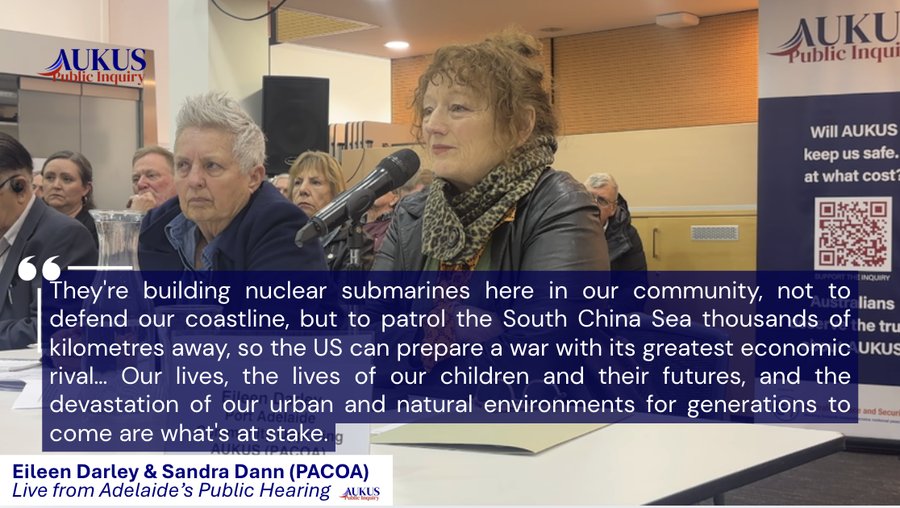
Eileen Darley & Sandra Dann (PACOA): “AUKUS is a war pact”
Port Adelaide Community Opposing AUKUS (PACOA)
“They're building nuclear submarines here in our community, not to defend our coastline, but to patrol the South China Sea thousands of kilometres away, so the US can prepare a war with its greatest economic rival… Our lives, the lives of our children and their futures, and the devastation of our urban and natural environments for generations to come are what's at stake.”
Featured Witness
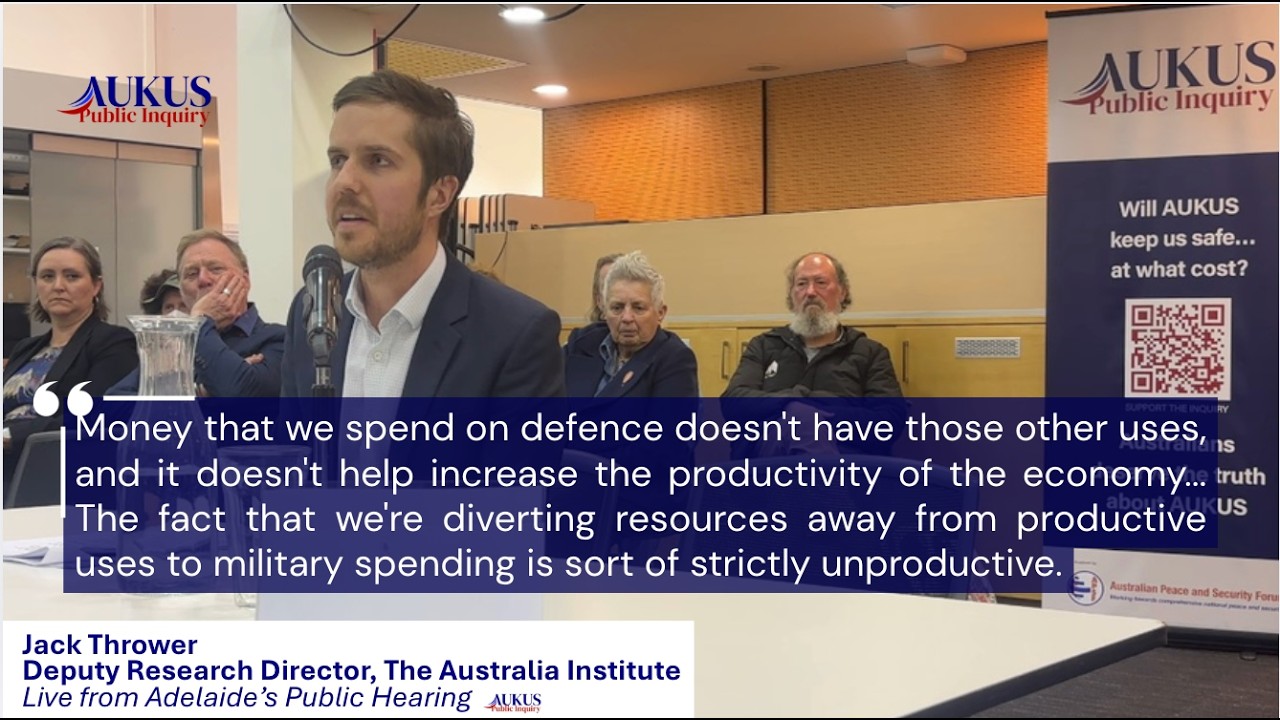
Jack Thrower: “$18.4 Million Per Job — That Isn't a Great Cost-Benefit”
The Australia Institute
“Money that we spend on defence doesn't have those other uses, and it doesn't help increase the productivity of the economy… The fact that we're diverting resources away from productive uses to military spending is sort of strictly unproductive.”
Featured Witness
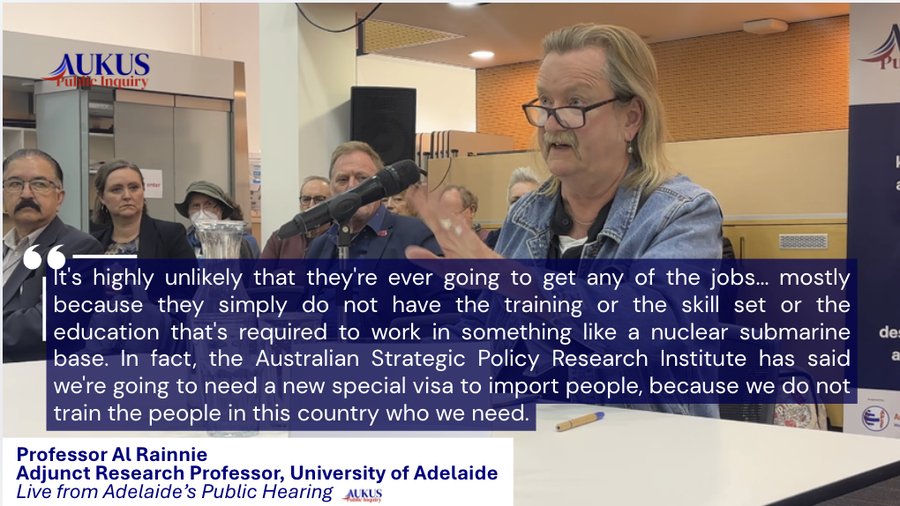
Al Rainnie: “It's Highly Unlikely They're Ever Going to Get Any of the Jobs”
Adjunct Research Professor, University of Adelaide
“It's highly unlikely that they're ever going to get any of the jobs… mostly because they simply do not have the training or the skill set or the education that's required to work in something like a nuclear submarine base. In fact, the Australian Strategic Policy Research Institute has said we're going to need a new special visa to import people, because we do not train the people in this country who we need.”
Featured Witness
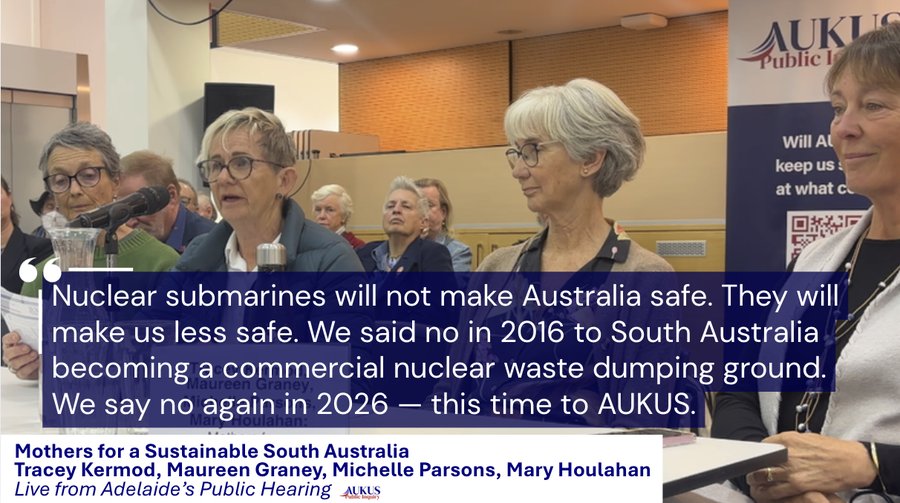
MOSSA: “It's Legally Our Waste Forever”
Tracey Kermond, Maureen Graney, Michelle Parsons & Mary Houlahan, Mothers for a Sustainable South Australia
“Nuclear submarines will not make Australia safe. They will make us less safe. We said no in 2016 to South Australia becoming a commercial nuclear waste dumping ground. We say no again in 2026 — this time to AUKUS.”
Featured Witness
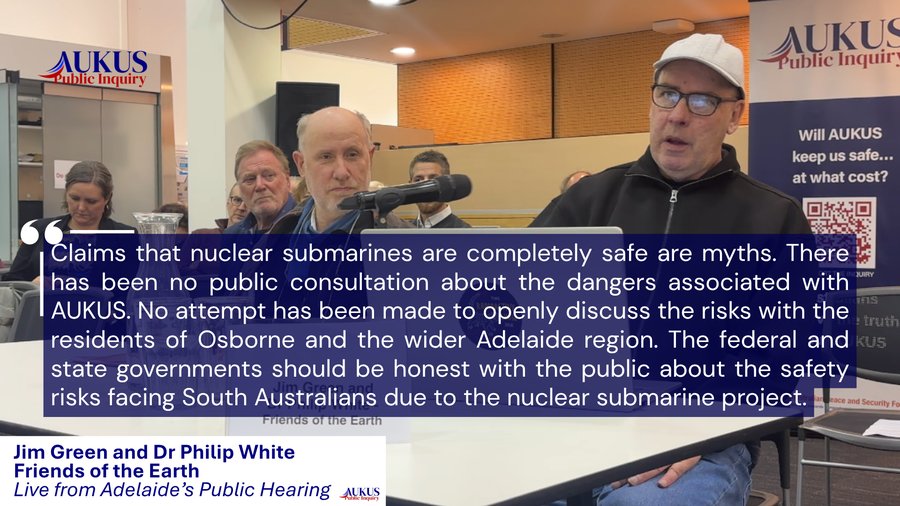
Friends of the Earth: “Claims That Nuclear Submarines Are Completely Safe Are Myths”
Jim Green and Dr Philip White, Friends of the Earth Adelaide
“Claims that nuclear submarines are completely safe are myths. There has been no public consultation about the dangers associated with AUKUS. No attempt has been made to openly discuss the risks with the residents of Osborne and the wider Adelaide region. The federal and state governments should be honest with the public about the safety risks facing South Australians due to the nuclear submarine project.”
Featured Witness
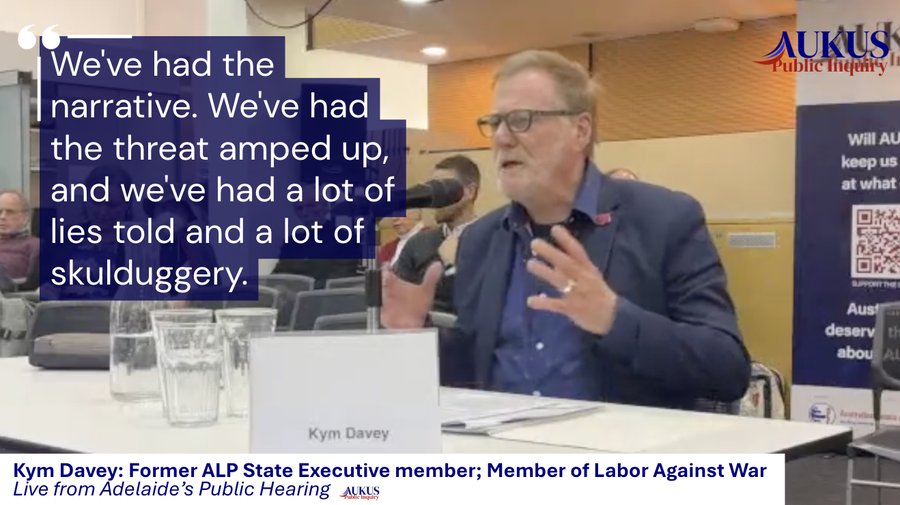
Kym Davey: “It's One Thing to Build Up Our Defences. It's Another to Be Part of an Aggressive Posture”
Former ALP State Executive Member; Member of Labor Against War
“We've had the narrative. We've had the threat amped up, and we've had a lot of lies told and a lot of skulduggery.”
Featured Witness
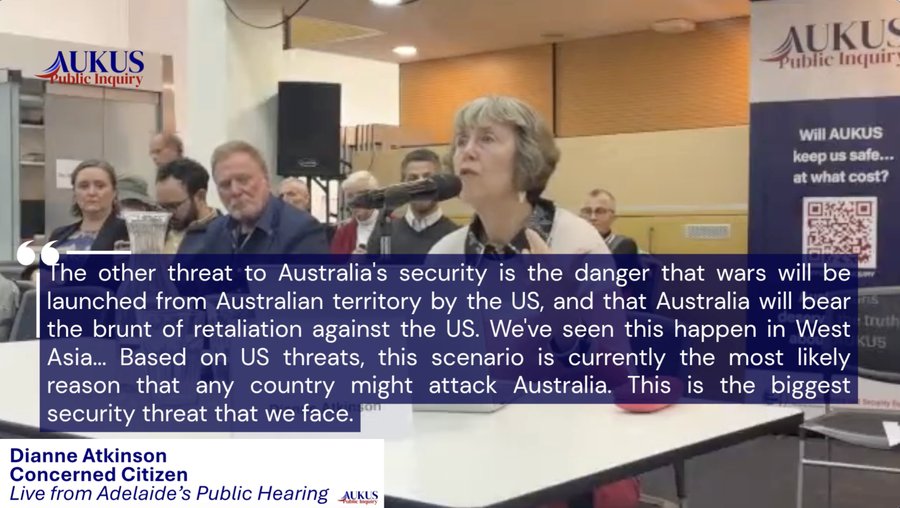
Dianne Atkinson: “This Is the Biggest Security Threat That We Face”
Concerned Citizen
“The other threat to Australia's security is the danger that wars will be launched from Australian territory by the US, and that Australia will bear the brunt of retaliation against the US. We've seen this happen in West Asia… Based on US threats, this scenario is currently the most likely reason that any country might attack Australia. This is the biggest security threat that we face.”
Featured Witness
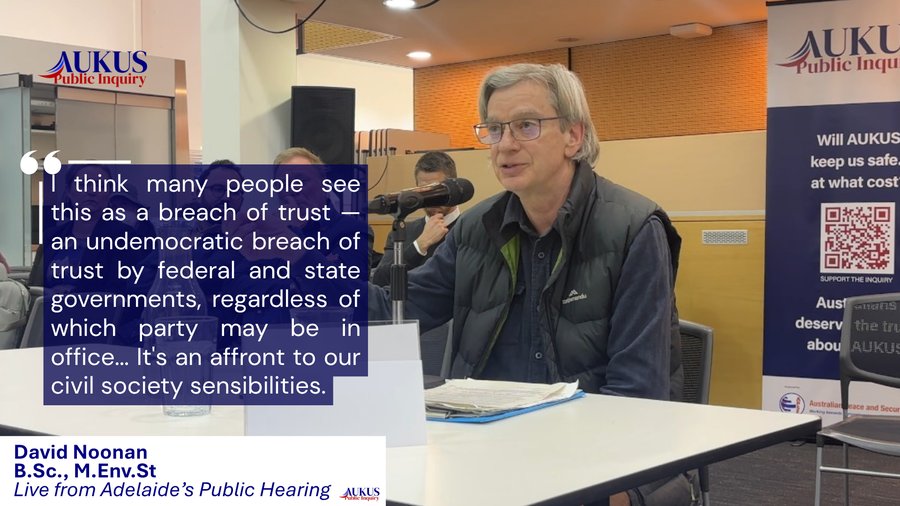
David Noonan: “An Undemocratic Breach of Trust”
B.Sc., M.Env.St
“I think many people see this as a breach of trust — an undemocratic breach of trust by federal and state governments, regardless of which party may be in office… It's an affront to our civil society sensibilities.”
Featured Witness
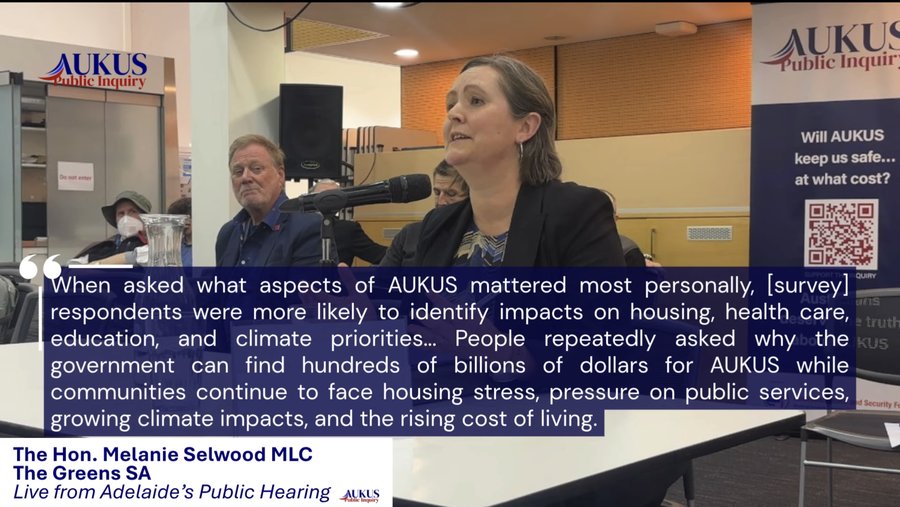
Melanie Selwood MLC: “93% Say Australians Haven't Been Given Enough Information About AUKUS”
The Greens SA
“When asked what aspects of AUKUS mattered most personally, [survey] respondents were more likely to identify impacts on housing, health care, education, and climate priorities… People repeatedly asked why the government can find hundreds of billions of dollars for AUKUS while communities continue to face housing stress, pressure on public services, growing climate impacts, and the rising cost of living.”
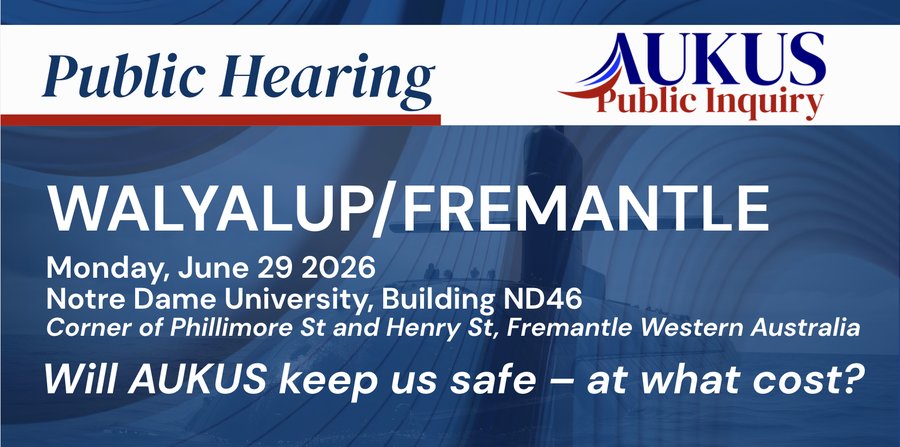
Fremantle / Walyalup — Full Hearing Livestream
Fremantle Public Hearing — 29 June 2026
University of Notre Dame Australia, Fremantle WA
The second public hearing of the AUKUS Public Inquiry was held in Fremantle/Walyalup, WA, with witnesses including former Defence Minister Linda Reynolds and Dr Colin Hughes, former WA Director of Public Health.
Featured Witness
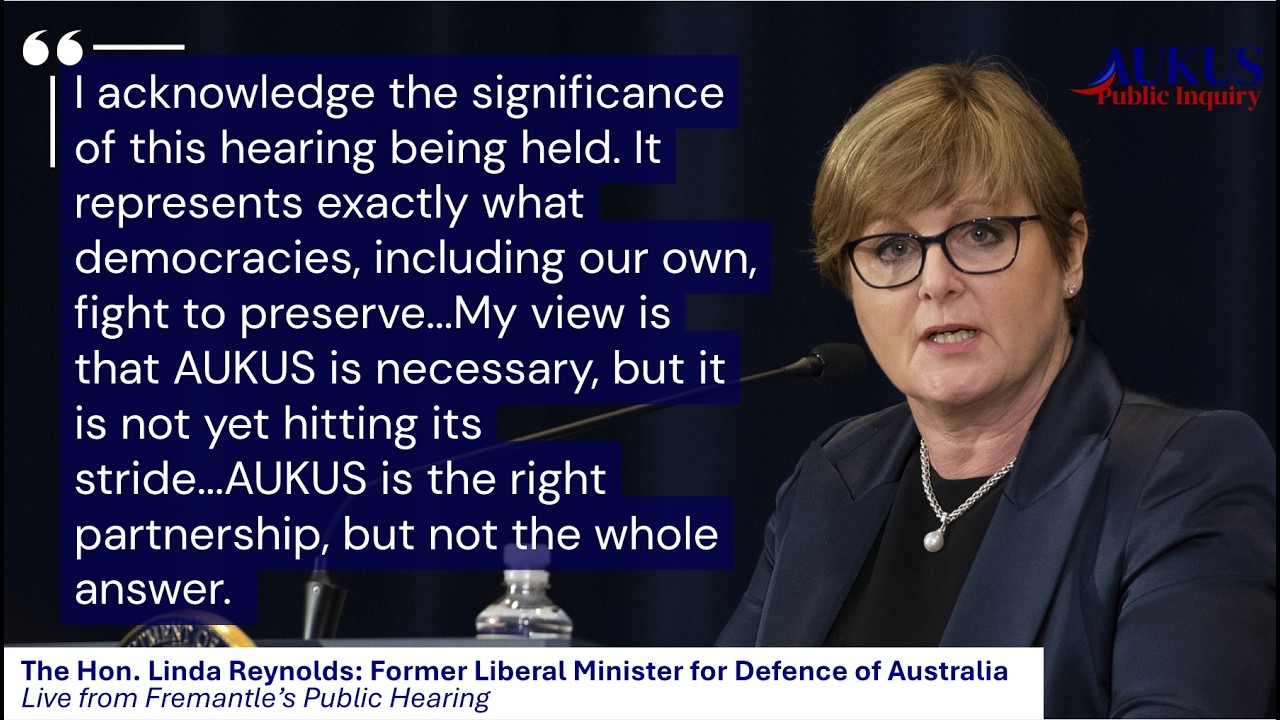
Linda Reynolds: “AUKUS is necessary but it has not yet hit its stride”
Former Minister for Defence of Australia
“I acknowledge the significance of this hearing being held. It represents exactly what democracies, including our own, fight to preserve…My view is that AUKUS is necessary, but it is not yet hitting its stride…AUKUS is the right partnership, but not the whole answer.”
Featured Witness
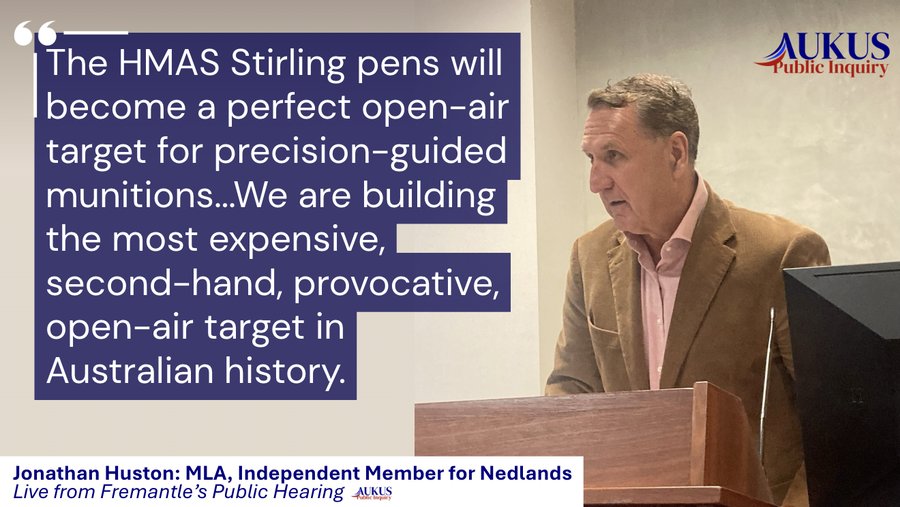
Jonathan Huston MLA: “HMAS Stirling pens will become a perfect open-air target”
Member of the Legislative Assembly of Western Australia, Independent Member for Nedlands
“The HMAS Stirling pens will become a perfect open-air target for precision-guided munitions…We are building the most expensive, second-hand, provocative, open-air target in Australian history.”
Featured Witness
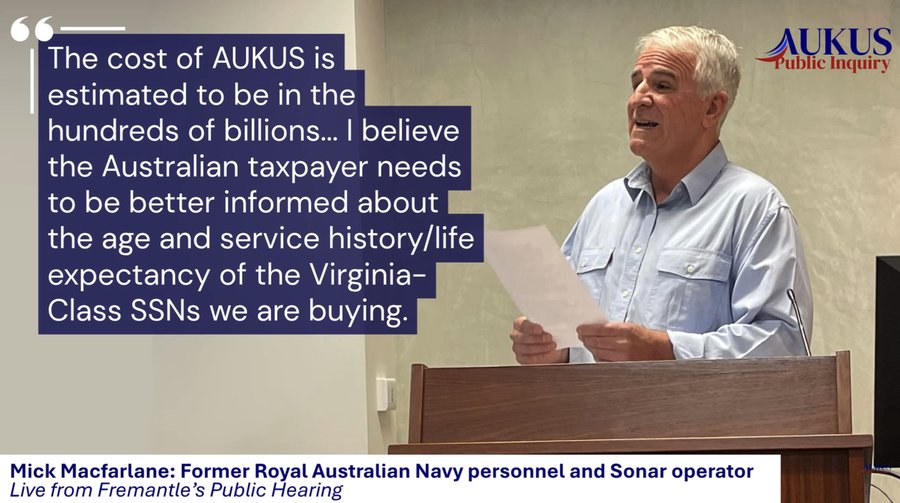
Mick Macfarlane: There are submarines and there are targets
Former Royal Australian Navy personnel and Sonar operator
“The cost of AUKUS is estimated to be in the hundreds of billions… I believe the Australian taxpayer needs to be better informed about the age and service history/life expectancy of the Virginia-Class SSNs we are buying.”
Featured Witness
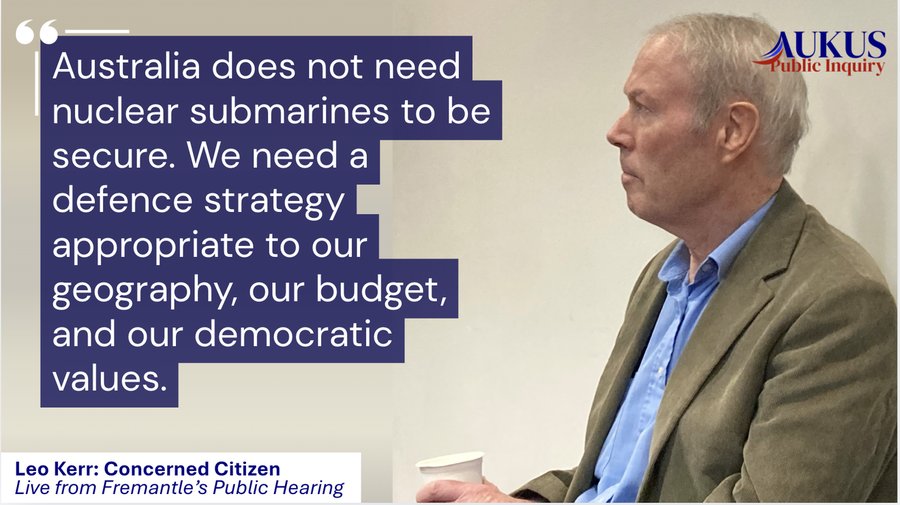
Leo Kerr: Citizen submission calls the $368 Billion deal a strategic blunder
Concerned Citizen
“Australia does not need nuclear submarines to be secure. We need a defence strategy appropriate to our geography, our budget, and our democratic values.”
Featured Witness
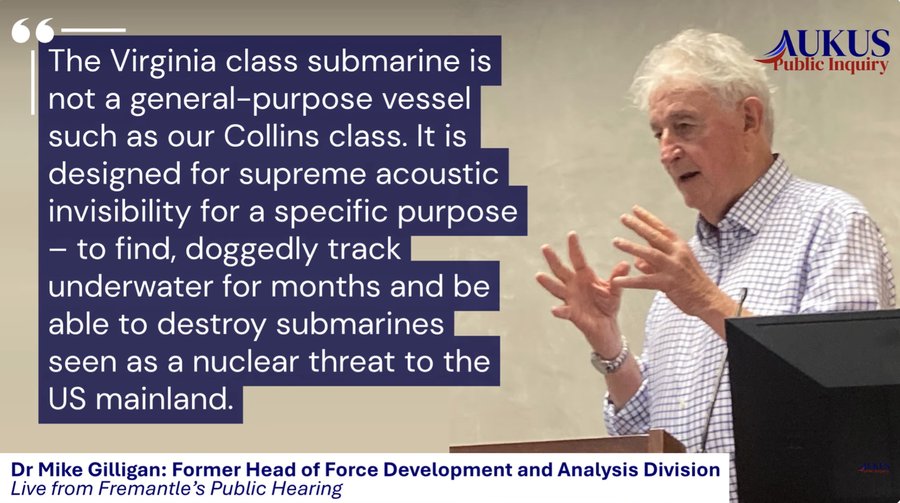
Dr Mike Gilligan: 20-Year Defence Analyst on how self-reliance died and AUKUS was born
Former Head of Force Development and Analysis Division, Department of Defence; Board Member, Pearls and Irritations
“The Virginia class submarine is not a general-purpose vessel such as our Collins class. It is designed for supreme acoustic invisibility for a specific purpose — to find, doggedly track underwater for months and be able to destroy submarines seen as a nuclear threat to the US mainland.”
Featured Witness
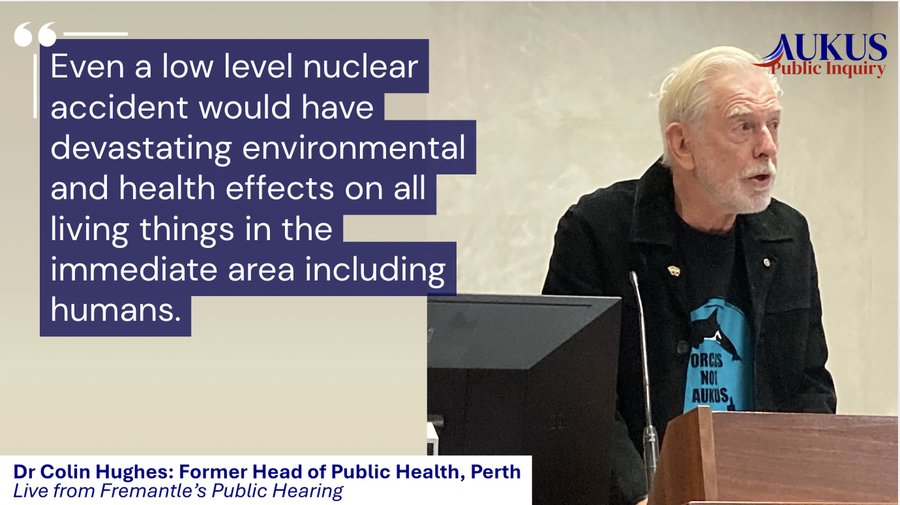
Dr Colin Hughes: Former head of Public Health paints a nuclear accident scenario for Rockingham
Former Head of Public Health, Perth Metro; Member, Medical Association for Prevention of War Australia
“Even a low level nuclear accident would have devastating environmental and health effects on all living things in the immediate area including humans.”
Featured Witness
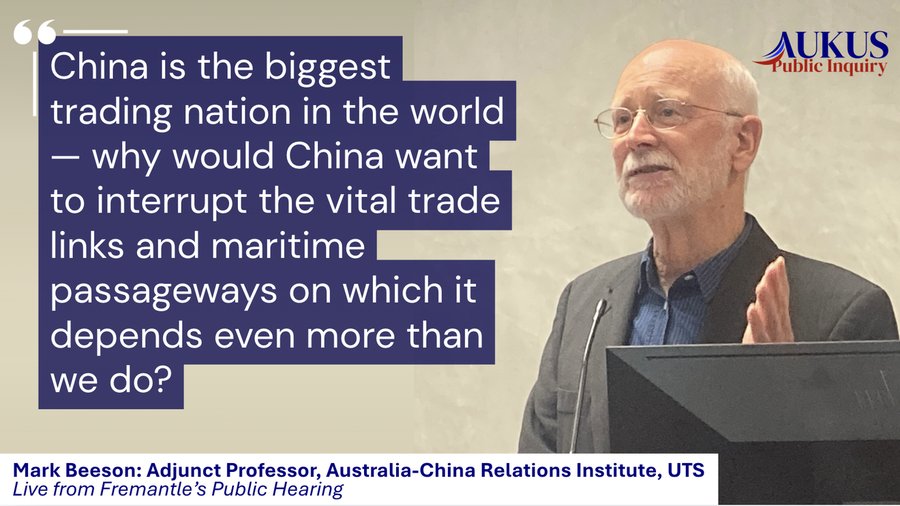
Mark Beeson: “It would be madness for China to even contemplate such a thing”
Adjunct Professor, Australia-China Relations Institute, University of Technology Sydney
“We could fix free education for higher education, we could fix the social housing problem, we could fix remote community problems with their housing, and, of course, make the green transition.”
Featured Witness
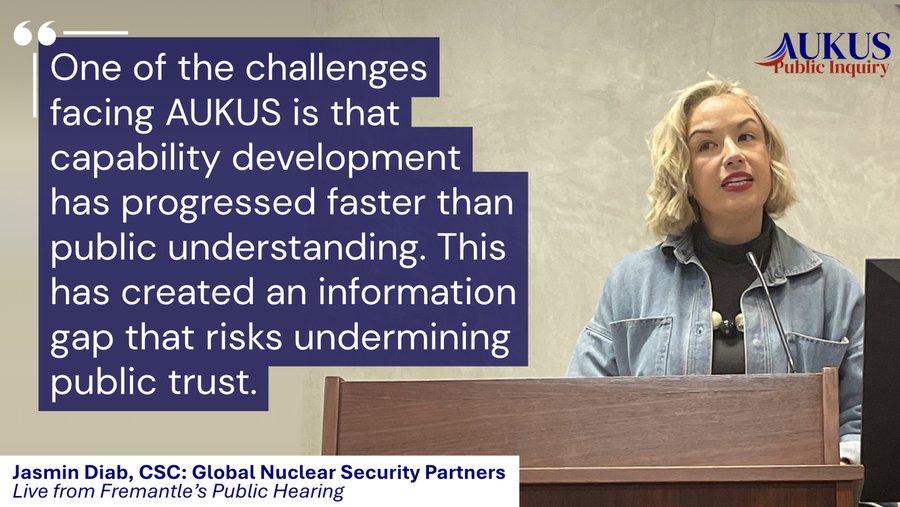
Jasmin Diab: “The True Measure of AUKUS Won’t Be the Submarines Themselves”
Partner and Managing Director Australia, Global Nuclear Security Partners
“One of the challenges facing AUKUS is that capability development has progressed faster than public understanding. This has created an information gap that risks undermining public trust.”
Featured Witness
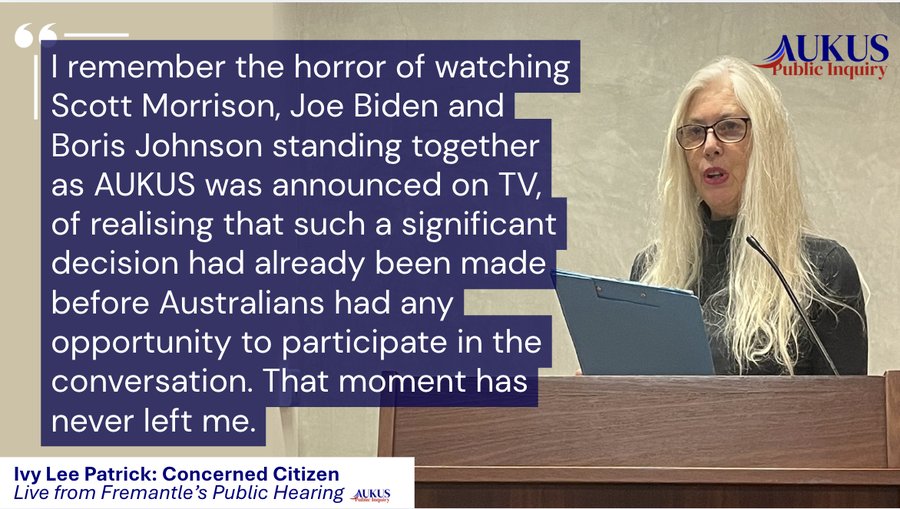
Ivy Lee Patrick: “I was not only grieving AUKUS itself”
Concerned Citizen
“I remember the horror of watching Scott Morrison, Joe Biden and Boris Johnson standing together as AUKUS was announced on TV, of realising that such a significant decision had already been made before Australians had any opportunity to participate in the conversation. That moment has never left me.”
Featured Witness
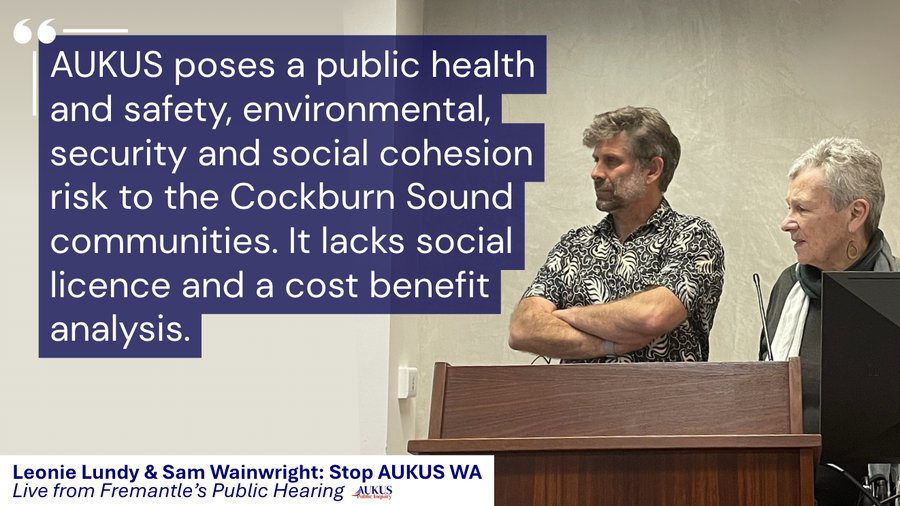
Stop AUKUS WA says AUKUS “debases our democracy” and “threatens our sovereignty”
Leonie Lundy & Sam Wainwright, Stop AUKUS WA
“AUKUS poses a public health and safety, environmental, security and social cohesion risk to the Cockburn Sound communities. It lacks social licence and a cost benefit analysis.”
Featured Witness
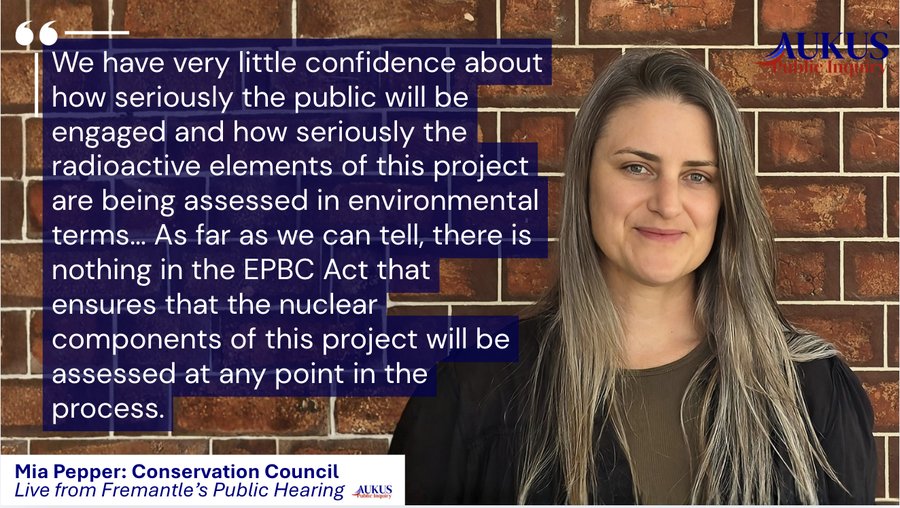
Mia Pepper: AUKUS “really spells disaster for some of the ecosystems”
Conservation Council of Western Australia
“We have very little confidence about how seriously the public will be engaged and how seriously the radioactive elements of this project are being assessed in environmental terms… As far as we can tell, there is nothing in the EPBC Act that ensures that the nuclear components of this project will be assessed at any point in the process.”
Featured Witness
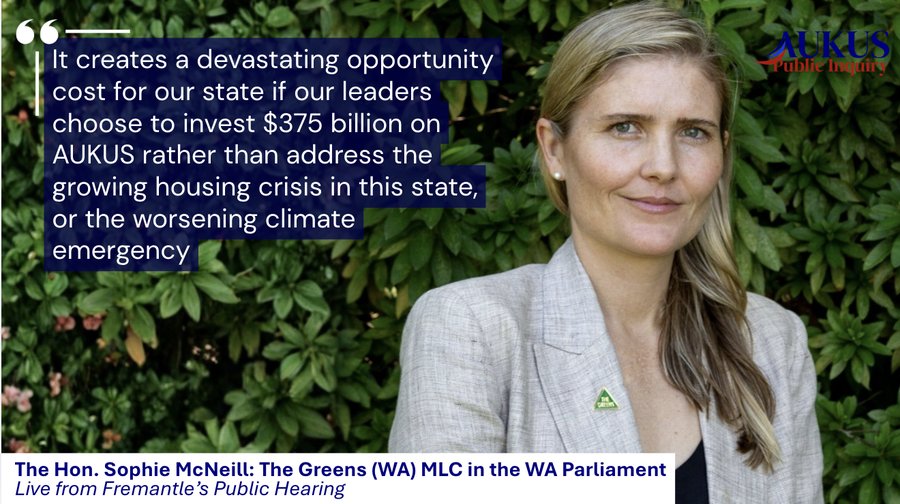
Sophie McNeill: Pensioners in tents while $100 million goes to housing US troops
The Greens (WA) MLC, WA Parliament — Fremantle / Walyalup Hearing, 29 June 2026
“It creates a devastating opportunity cost for our state if our leaders choose to invest $375 billion on AUKUS rather than address the growing housing crisis in this state, or the worsening climate emergency.”
Featured Witness
Dennis Rumley: “We, the Australian people, have not agreed to this”
Emeritus Professor; Political Geographer
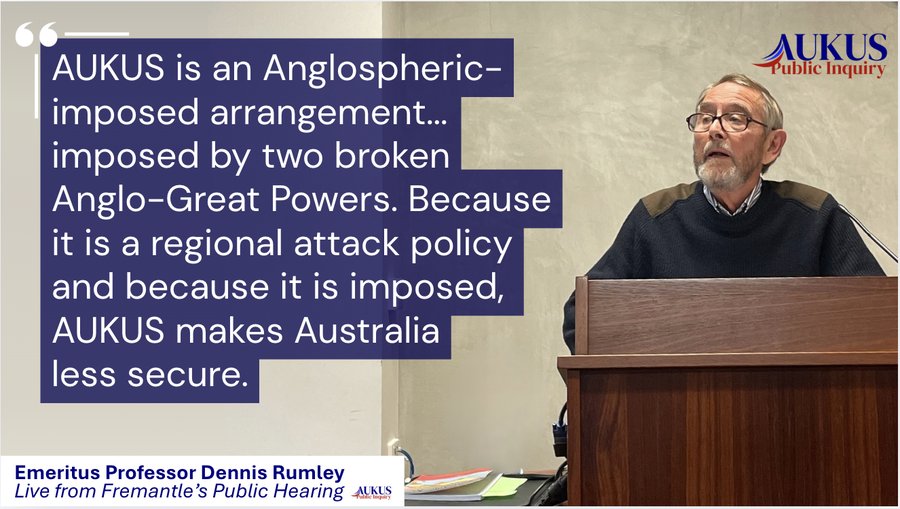
“AUKUS is an Anglospheric-imposed arrangement… imposed by two broken Anglo-Great Powers. Because it is a regional attack policy and because it is imposed, AUKUS makes Australia less secure.”
Featured Witness
KA Garlick: “AUKUS asks Western Australians to accept radioactive waste without a permanent solution”
Nuclear Free WA
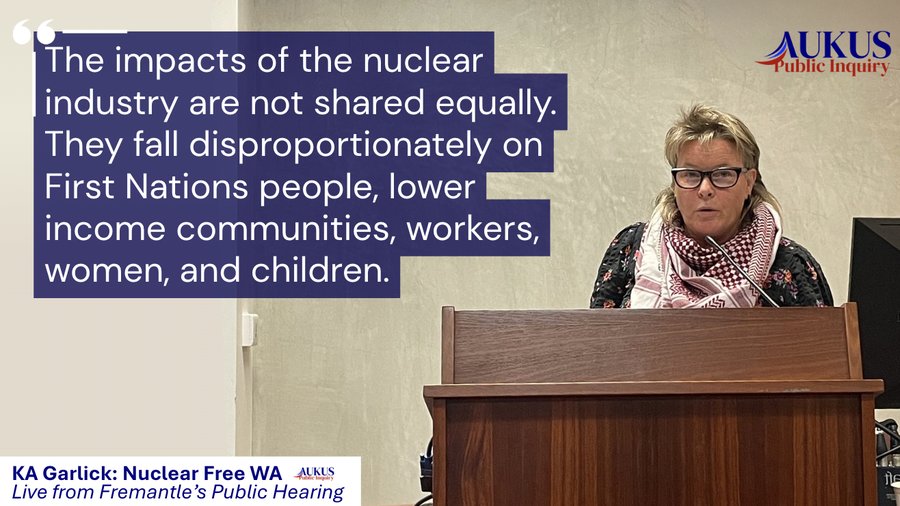
“The impacts of the nuclear industry are not shared equally. They fall disproportionately on First Nations people, lower income communities, workers, women, and children.”
Melbourne / Naarm — Full Hearing Livestream
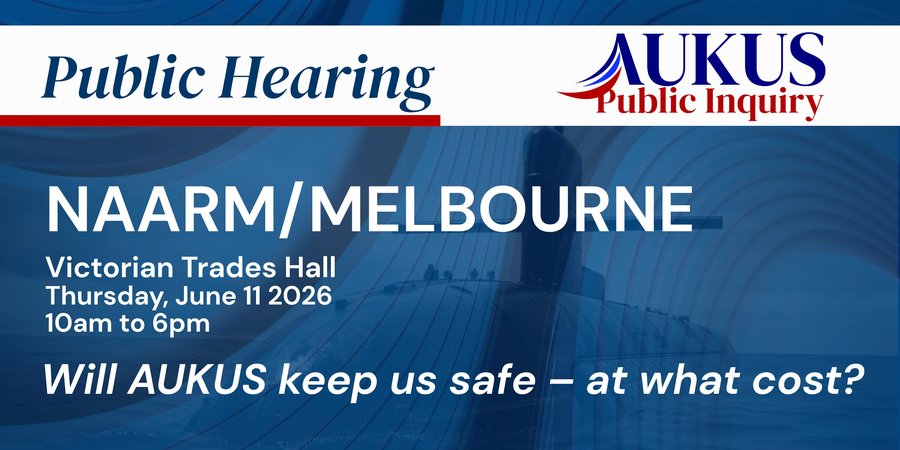
Melbourne / Naarm — June 11, 2026
The first public hearing of the AUKUS Public Inquiry was held at the Victorian Trades Hall in Melbourne. Commissioners heard from a range of expert witnesses, academics, former defence officials, and members of the public on the strategic, financial, environmental, and sovereignty implications of the AUKUS deal.
Watch the full hearing above or view on YouTube →
Featured Witness
Gareth Evans: AUKUS was “misconceived from the outset”
Former Minister for Foreign Affairs in the Hawke and Keating Governments (1988–96); former President & CEO, International Crisis Group
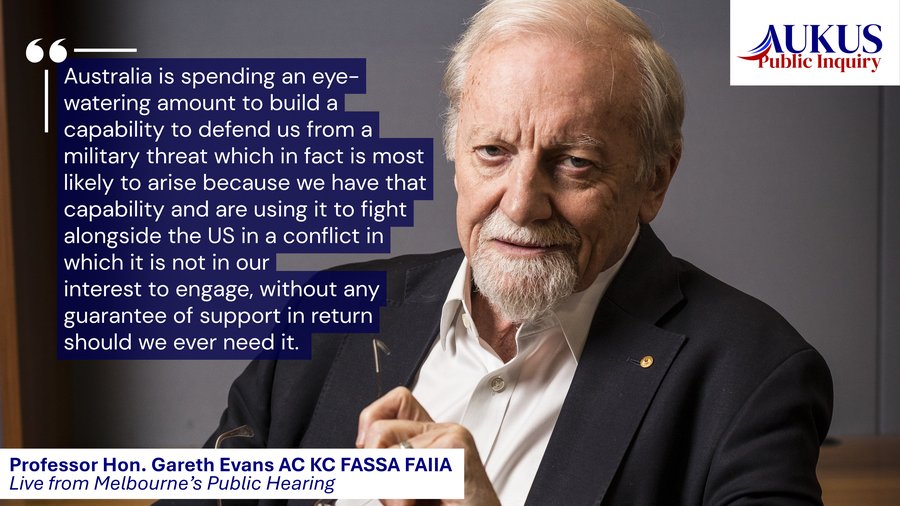
“Australia is spending an eye-watering amount to build a capability to defend us from a military threat which in fact is most likely to arise because we have that capability and are using it to fight alongside the US in a conflict in which it is not in our interest to engage, without any guarantee of support in return should we ever need it.”
Featured Witness
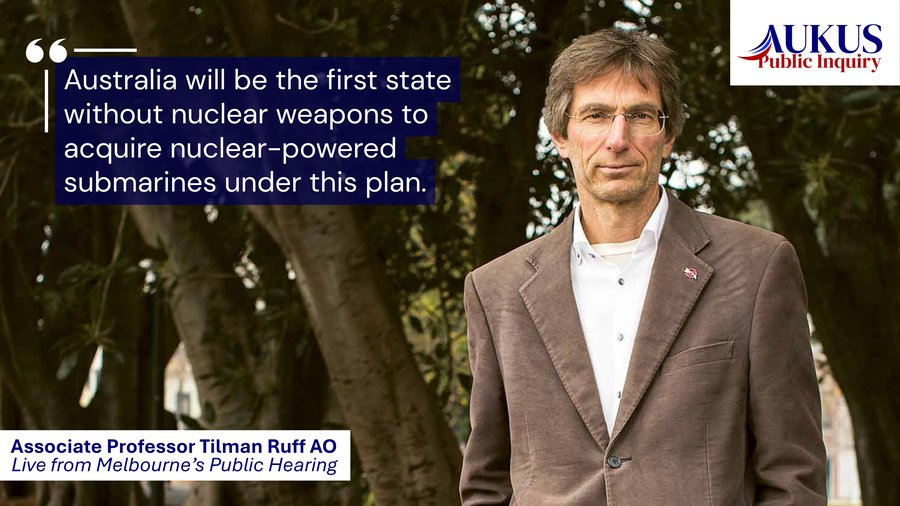
Tilman Ruff: Australia would be “the first non-nuclear state to acquire nuclear-powered submarines”
Co-founder, International Campaign to Abolish Nuclear Weapons (ICAN); Nossal Institute for Global Health, University of Melbourne
“Australia will be the first state without nuclear weapons to acquire nuclear-powered submarines under this plan.”
Featured Witness
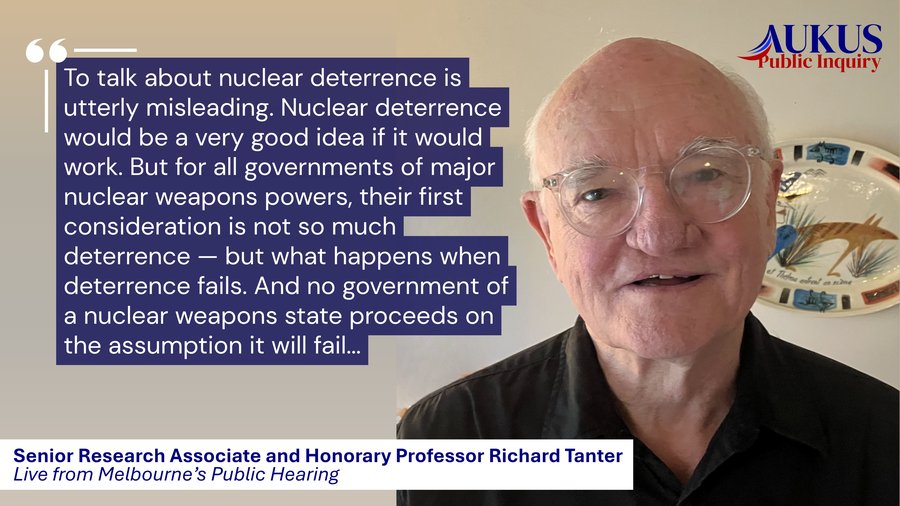
Richard Tanter: Australia’s nuclear permissiveness is “something we should not be tolerating”
Senior Research Associate, Nautilus Institute; Honorary Professor, University of Melbourne
“To talk about nuclear deterrence is utterly misleading. Nuclear deterrence would be a very good idea if it would work. But for all governments of major nuclear weapons powers, their first consideration is not so much deterrence — but what happens when deterrence fails. And no government of a nuclear weapons state proceeds on the assumption it will fail…”
Featured Witness
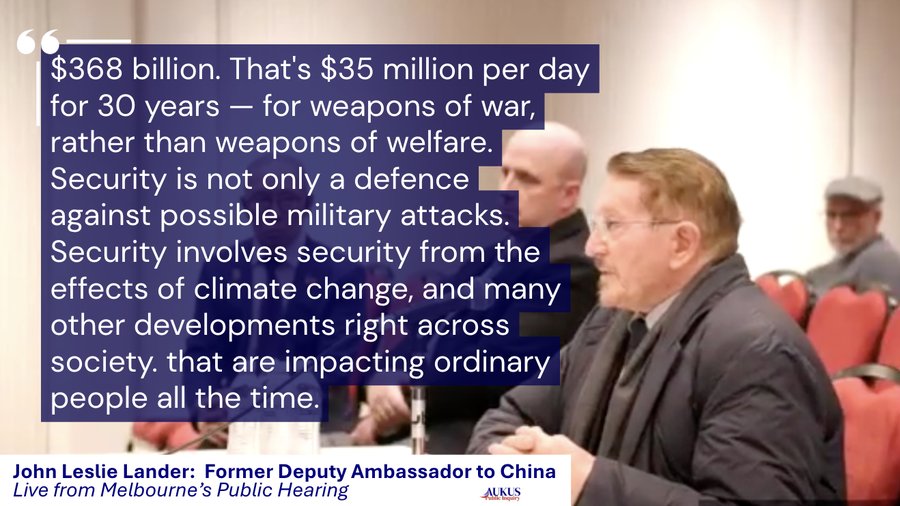
John Leslie Lander: Australia is paying $35 Million a day for a fictional threat
Former Deputy Ambassador to China and Head of the China Section, DFAT
“$368 billion. That's $35 million per day for 30 years — for weapons of war, rather than weapons of welfare. Security is not only a defence against possible military attacks. Security involves security from the effects of climate change, and many other developments right across society that are impacting ordinary people all the time.”
Featured Witness
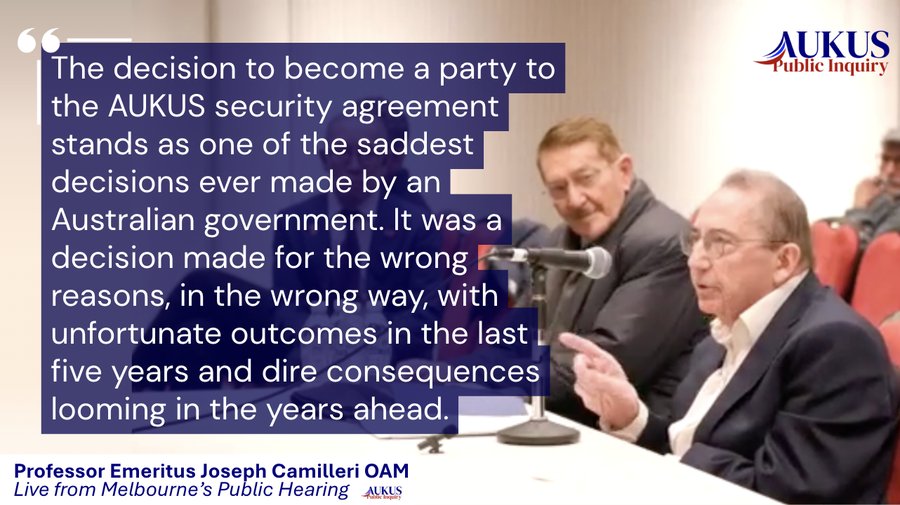
Joseph Camilleri: “One of the saddest decisions ever made by an Australian Government”
Professor Emeritus, La Trobe University
“The decision to become a party to the AUKUS security agreement stands as one of the saddest decisions ever made by an Australian government. It was a decision made for the wrong reasons, in the wrong way, with unfortunate outcomes in the last five years and dire consequences looming in the years ahead.”
Featured Witness
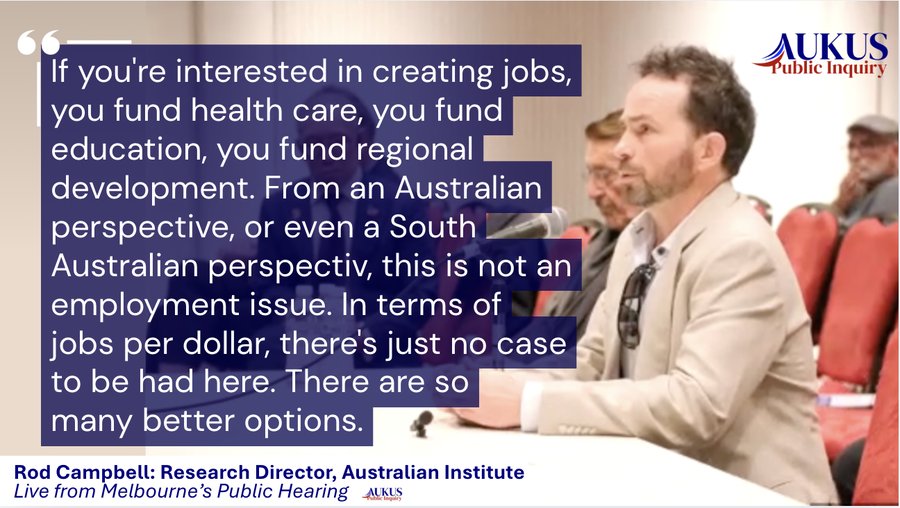
Rod Campbell: “There’s just no case to be had here”
Research Director, Australian Institute
“If you’re interested in creating jobs, you fund health care, you fund education, you fund regional development. From an Australian perspective, or even a South Australian perspective, this is not an employment issue. In terms of jobs per dollar, there’s just no case to be had here. There are so many better options.”
Featured Witness
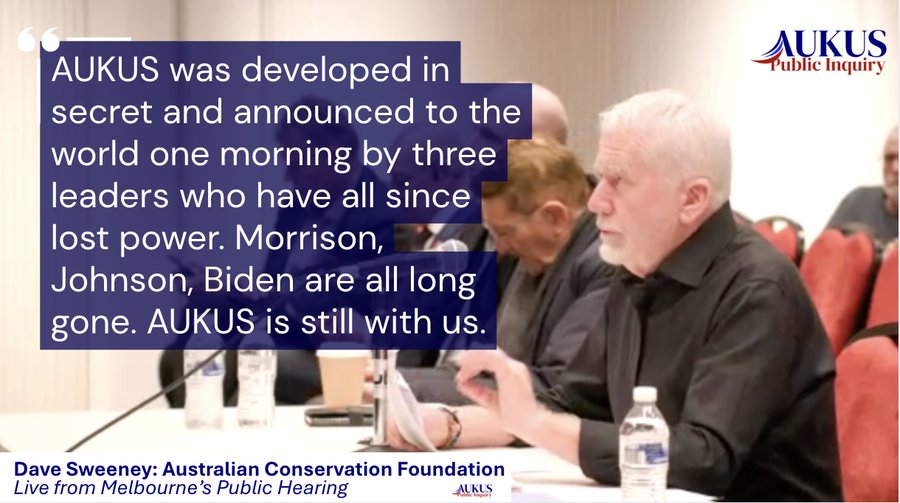
Dave Sweeney: “We don’t ask, they don’t tell”
Anti-Nuclear Campaigner, Australian Conservation Foundation
“AUKUS was developed in secret and announced to the world one morning by three leaders who have all since lost power. Morrison, Johnson, Biden are all long gone. AUKUS is still with us.”
Featured Witness
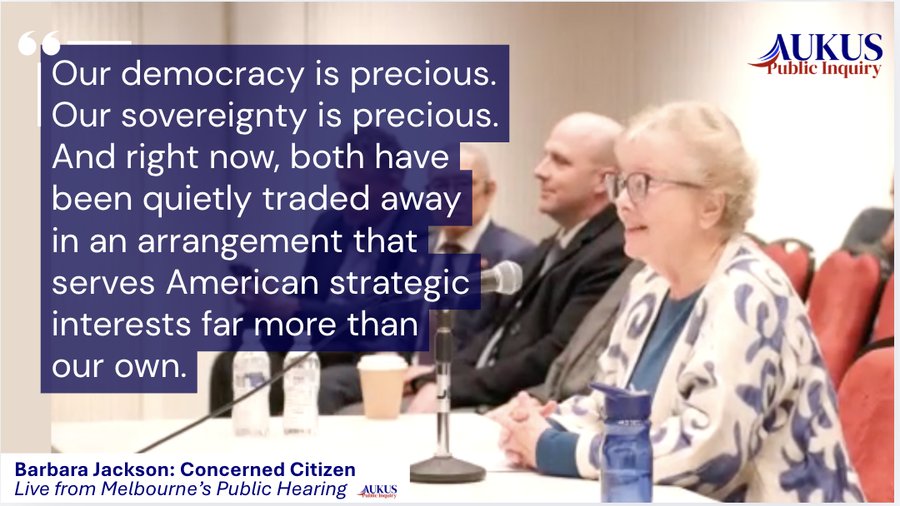
Barbara Jackson: AUKUS has “quietly traded away” Australia’s democracy and sovereignty
Concerned Citizen
“Our democracy is precious. Our sovereignty is precious. And right now, both have been quietly traded away in an arrangement that serves American strategic interests far more than our own.”
Featured Witness
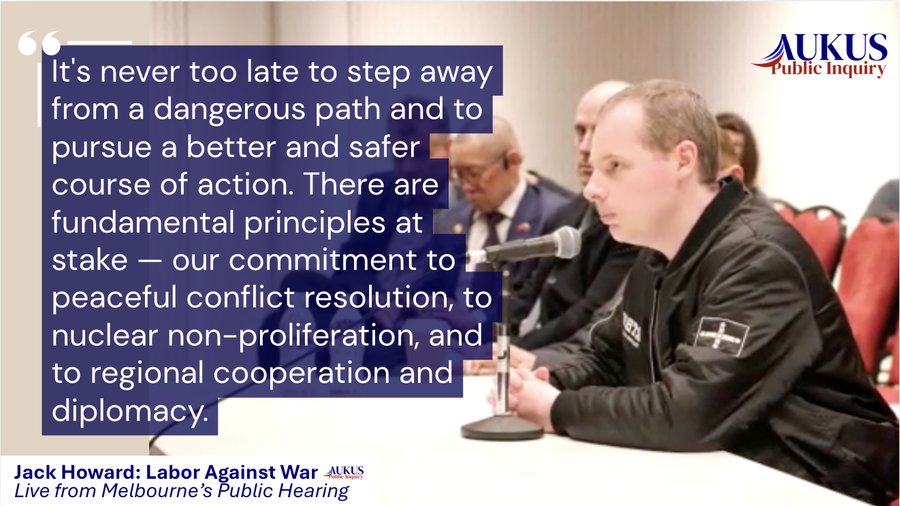
Jack Howard: “It's Never Too Late to Step Away From a Dangerous Path”
Labor Against War
“It's never too late to step away from a dangerous path and to pursue a better and safer course of action. There are fundamental principles at stake — our commitment to peaceful conflict resolution, to nuclear non-proliferation, and to regional cooperation and diplomacy.”
Featured Witness
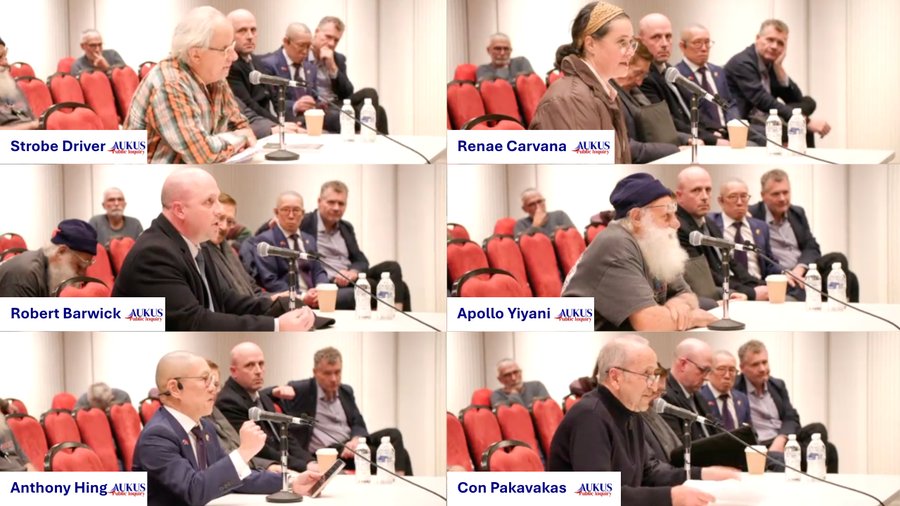
Melbourne 5-Minute Community Voices
Strobe Driver, Robert Barwick, Anthony Hing, Renae Carvana, Apollo Yiyani & Con Pakavakas
Six community members addressed the AUKUS Public Inquiry's Melbourne hearing in a series of five-minute presentations, bringing perspectives ranging from war studies research to lived experience in education, business, and activism.
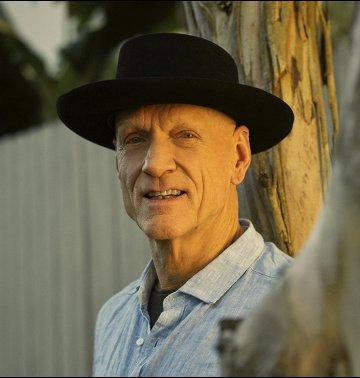
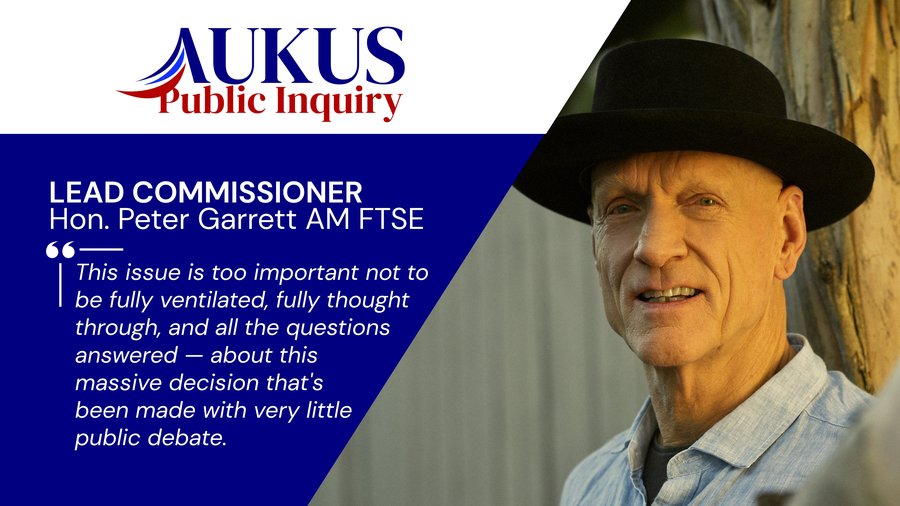
The Hon Peter Garrett AM FTSE — Lead Commissioner
The Inquiry's full Terms of Reference — including objectives, scope, methodology, timeframe and governance — are publicly available.
The Inquiry will commence early June 2026 and produce a final report by 4 November 2026. It will be directed by five eminent Australians as Commissioners, convened under the auspices of the Australian Peace and Security Forum.
We need funding for travel for commissioners and expert witnesses, event spaces for public hearings, accommodation and logistics, and documentation and public reporting. Every contribution helps bring accountability to the largest defence decision in Australia's history.
All contributions will be regularly audited.